Closing the Last-Mile Automation Gap Between AI and Your Database
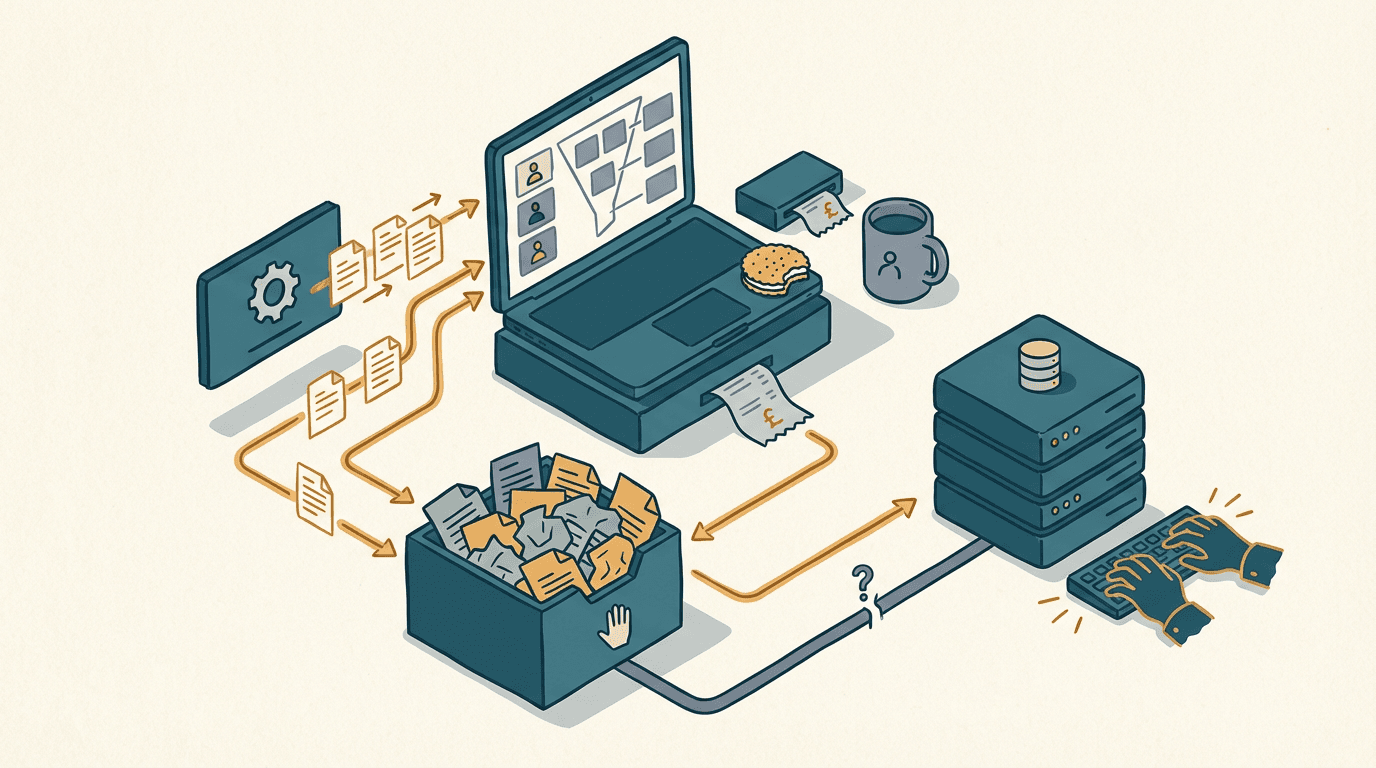
Picture your ops manager on a Thursday afternoon. She has Xero open on her left monitor and a shared Outlook inbox on her right. You just bought ChatGPT Plus subscriptions for the entire team to boost productivity. Yet she's still manually copying line items from a logistics supplier's PDF into your accounting software.
She isn't ignoring your new tech mandate. She just knows that a chat window can't securely log into your ledger, check the supplier's historical nominal codes, and post a reconciled invoice.
The work isn't writing emails. The work is moving structured data between walled gardens. Until the bot can do that, your headcount stays exactly where it is.
The last-mile automation gap
The last-mile automation gap is the structural disconnect between an AI generating a correct answer in a browser and that answer autonomously updating your core business systems. It's the reason you feel like you're paying for technology but still paying for the exact same amount of human effort.
The British Chambers of Commerce released data in March 2026 showing that 54% of UK firms actively use AI. That's a massive jump from previous years.
But pay attention to this part. Of the SMEs using it, 95% report zero impact on workforce size. Job roles remain entirely unchanged.
The BCC Insights Unit found that professional services firms are leading adoption, but even there, the headcount remains static. They're buying the tools, handing them to staff, and hoping productivity magically increases. It doesn't.
You buy generic subscriptions expecting a revolution. You get a slightly faster way to draft a polite email to a difficult client. The needle doesn't move.
This happens because off-the-shelf AI tools are isolated. They sit outside your operational flow. Your accounts assistant still has to download the output, format it, and paste it into QuickBooks. The human is acting as the API between the AI and your database.
That manual bridge is expensive. It destroys the ROI of the software. You're effectively paying a £35k salary to a human copy-and-paste bot.
The gap persists because software vendors sell you the intelligence, but they leave the integration entirely up to you. They give you a brilliant brain in a jar. It has no hands to type into your CRM and no eyes to read your live ledger.
Why the Zapier-to-ChatGPT pipeline breaks
The Zapier-to-ChatGPT pipeline breaks because generic automation tools can't handle the complex, nested data structures required by accounting software. Most SMEs spot the gap and try to patch it cheaply. The standard playbook is stringing together Zapier flows, feeding emails into OpenAI, and trying to push the result into a CRM like HubSpot or Pipedrive. Or worse, they hire a junior analyst to run the AI automations.
Stop buying ChatGPT Plus for your ops team. It's a distraction. The problem you have isn't text generation. It's system integration.
You can't fix this by switching from ChatGPT to Claude. The model isn't the bottleneck. The bottleneck is the connective tissue between the model and your database.
Here's what actually happens when you try the standard Zapier route. You set up a trigger for new emails. You pass the PDF attachment text to an AI prompt. You ask it to output the supplier name, total, and tax amount. The AI does this perfectly.
Then the Zapier flow hits your accounting software. Zapier's native Find steps can't easily nest or handle complex conditional logic. If your Xero supplier has a custom contact field two levels deep, or if the AI outputs "Ltd" instead of "Limited", the generic integration chokes.
The automation silently writes null to the database. It skips the line item entirely. You only notice at month-end when your bank reconciliation fails and your bookkeeper spends three days untangling the mess.
In my experience, most SMEs who try this hit the exact same wall. They build a fragile daisy-chain of basic triggers. The moment a supplier changes their invoice layout, the schema breaks. The AI hallucinates a slightly different JSON structure, Zapier panics, and the data vanishes.
You end up turning the automation off. You go back to manual entry because a slow human is better than a fast, silent error. The generic tools are built for simple, linear tasks. They fail completely when exposed to the messy, unstructured reality of SME supply chains.
Building bespoke middleware

Bespoke middleware is custom, API-driven infrastructure that forces an AI model to output validated, strictly formatted data directly into your database. The 10% of businesses actually seeing structural changes to their headcount are the ones building these workflows.
Here's a real worked example. You receive complex, multi-line invoices from a freight forwarder. They arrive as PDFs in a shared Outlook inbox.
First, you ditch Zapier. You use an industrial automation engine like Make or n8n. A webhook in n8n catches the incoming Outlook email. It strips the PDF and sends it directly to the Claude API.
You don't use a generic prompt. You hit Claude with a strict JSON schema. You tell the API exactly what keys to return: invoice number, date, net amount, tax amount, and an array of line items. You also pass Claude a static mapping of your specific Xero nominal codes.
Claude reads the PDF, extracts the data, and maps the freight charges to code 310 and the customs duties to code 320. n8n receives this perfectly structured JSON.
Next, n8n runs a mathematical validation step. It checks if the sum of the line items equals the total net amount. It checks if the tax is exactly 20%.
If the math checks out, n8n uses an HTTP PATCH request to push the data directly into the Xero invoice endpoint. The invoice lands in Xero as a draft, fully coded, ready for a single click of approval.
If the math fails, say Claude hallucinated a decimal point, n8n routes the JSON to a dedicated Slack channel. It pings your accounts assistant with the original PDF and the extracted data, asking for a human review.
You also need to handle rate limits and API timeouts. A production-grade n8n workflow includes automatic retries and error catching. If the Xero API goes down for five minutes, your webhook queues the payload instead of dropping it on the floor.
This is how you cross the last-mile automation gap. You build a system that handles the exceptions gracefully. You don't let the AI touch the live ledger without a deterministic math check in the middle.
Building this exact flow takes about 2-3 weeks of focused development. You should expect to spend £6k-£12k depending on how messy your existing integrations are.
That sounds like a lot until you realise it replaces 15 hours of manual data entry every single week. It doesn't call in sick. It doesn't get bored and transpose numbers. It just works, silently, in the background.
The legacy data trap
The legacy data trap is the point where pristine AI logic crashes into decades of unstandardised, messy company records. This approach is powerful, but it isn't magic. You need to know exactly where it falls apart before you commit budget.
If your suppliers send invoices as scanned TIFFs from a 1990s ERP system, or if your warehouse still uses handwritten delivery notes, don't start with an LLM. You need dedicated Optical Character Recognition (OCR) first, like AWS Textract. If you feed garbage scans straight to Claude, the error rate jumps from 1% to roughly 12%.
Also, look at your underlying database. If your Xero is a disaster zone with 400 duplicate supplier contacts and nominal codes that nobody has audited since 2019, the AI will guess wrong. It will map data to the wrong account because your logic is flawed.
Clean your house first. Standardise your supplier names. Archive the old ledger codes. The AI can only automate a process that actually makes sense.
Another breaking point is complex approval hierarchies. If an invoice needs sign-off from three different department heads based on shifting project budgets, don't try to code that into the automation. Push it to a single approval queue in Teams and let the humans fight it out.
If your internal operations rely on a specific ops manager remembering that "Supplier A" is actually "Company B" on Tuesdays, the bot will fail. AI exposes bad processes. It doesn't fix them.
The question isn't whether AI replaces your ops manager. It's whether you know which £32k of her week is actually spent reconciling Xero against Stripe, because that's the only part a bot can touch this year. You can't buy your way out of manual work with a £25 monthly subscription. You have to build the bridge between the intelligence and your database. Until you stop treating AI as a chatbot and start treating it as a programmable reasoning engine embedded in your operations, your headcount won't budge. The businesses pulling ahead right now aren't the ones with the most generic licenses. They're the ones quietly wiring their core systems together, letting the machines talk to the machines, and leaving the humans to actually run the company.
Get our UK AI insights.
Practical reads on AI for UK businesses — teardowns, how-to guides, regulatory news. Unsubscribe anytime.
Unsubscribe anytime.