Why SMEs Should Stop Hiring the £28k Human Router
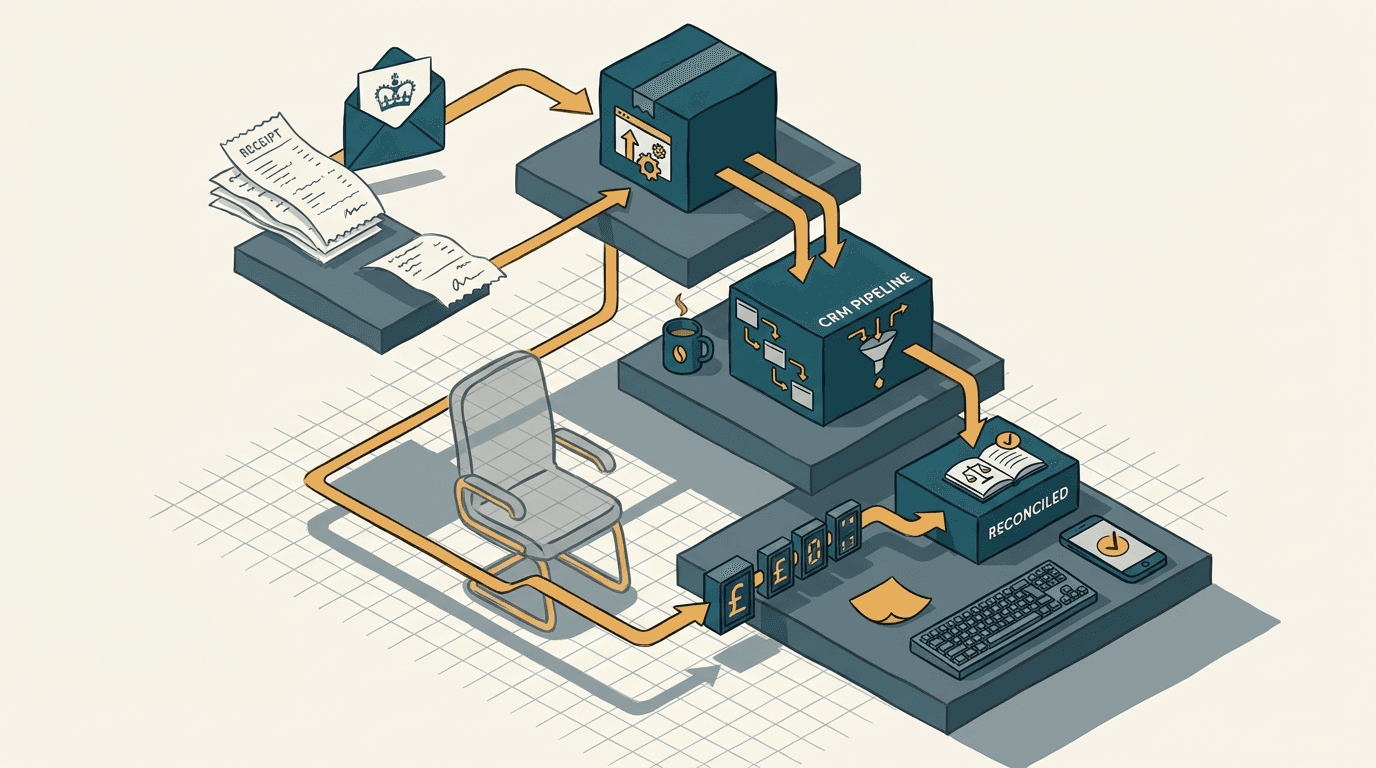
You're staring at a stack of CVs for a junior accounts assistant. The salary band is £25,000 to £28,000. The job description is essentially reading PDF attachments in an Outlook shared inbox, checking if the supplier name matches a record in Pipedrive, and typing the line items into Xero. You're about to hire a human being to act as a very slow API integration. Half of UK executives now expect AI to cut jobs within a decade, as shown in an April 2026 Accenture survey [source](https://www.bloomberg.com/news/articles/2026-04-20/half-of-uk-executives-expect-ai-to-cut-jobs-within-a-decade). But that headline misses the reality on the ground for SMEs. You aren't firing your ops manager. You're just realising that the entry-level pipeline you relied on to handle manual data entry is fundamentally broken.
The £28k human router
The £28k human router is the entry-level employee hired solely to move unstructured data between software platforms that refuse to talk to each other.
It's a structural flaw in how SMEs scale. You hit £3M in revenue and the volume of incoming supplier invoices, customer queries, and shipping manifests exceeds what your core team can process. So you hire a junior analyst or an administrative assistant.
Their entire working week is spent copying text from a Gmail thread and pasting it into a custom field in HubSpot. They don't make decisions. They just route data. End of.
The Accenture data shows executives expect headcount reductions, but the reduction isn't a mass layoff of senior staff. It's the freezing of these specific entry-level roles. Businesses are stopping the influx of £28k human routers.
This persists because founders look at the cost of enterprise integration and balk. A custom Salesforce to Xero bridge might cost £40,000 to build and maintain. Hiring a graduate feels cheaper and more flexible.
If the invoice format changes, the graduate adapts. If an API breaks, the whole system stops. So you pay the salary year after year.
But that maths changes when you introduce large language models capable of parsing unstructured text. The role of the human router is obsolete. They are a symptom of disconnected systems, not a driver of growth. When you rely on humans to bridge software gaps, you cap your operational speed at human typing speed.
You can't build a resilient company on the back of manual copy-pasting. Every time that junior employee goes on annual leave, your invoicing cycle grinds to a halt. You end up with a backlog of unentered bills, and your cash flow forecasting becomes a guessing game. The human router is a temporary patch that becomes a permanent liability.
Why the off-the-shelf Zapier stack fails
The off-the-shelf Zapier stack fails because it requires perfectly structured data to function, which your suppliers and clients will never provide.
Popular AI advice says you just connect your inbox to ChatGPT via Zapier, extract the details, and push them to your CRM. I see founders try this constantly. It's the wrong approach.
Zapier and Make rely on predictable schemas. You set up a Zap to trigger on a new Outlook email. The trigger fires. You pass the body text to an OpenAI module to extract the invoice amount and supplier name. Then you map those outputs to a Xero Create Bill step.
Here's what actually happens. Zapier's Find steps can't handle nested logic gracefully. When your supplier sends an invoice with a custom contact field two levels deep, or puts the total amount in a table cell that the parser misreads as a date, the automation silently writes null.
Zapier doesn't know it failed. It just pushes an empty value or a hallucinated number into Xero. You only notice at month-end when your bookkeeper asks why a £4,000 supplier payment is logged as £40.
You think you're saving money on a junior hire. Instead, you're spending £50 a month on software subscriptions and £15,000 in hidden reconciliation costs fixing silent errors. The tools are brittle. They assume a clean world.
SMEs operate in a messy world of scanned PDFs, forwarded email chains, and typos. A basic LLM prompt inside a linear Zap can't handle that variance. It breaks at the first sign of ambiguity. And yes, that's annoying. You end up spending more time babysitting the automation than you would have spent just typing the data yourself.
When I audit these setups, the failure rate on nested JSON is near 100 percent. Founders assume the AI is smart enough to figure out the mapping. It isn't. The LLM might extract the right text, but the rigid integration layer drops it on the floor. Linear automations die when faced with human inconsistency. You cannot fix this by writing a longer prompt. The failure happens in the routing layer, not the reasoning layer. If the API expects a string and gets an array, the process dies.
Building asynchronous validation loops

Building asynchronous validation loops means using an orchestrator to extract data, score its own confidence, and flag exceptions for human review before anything hits your ledger.
A supplier emails a multi-page PDF manifest for a complex logistics order. Not a clean digital file, but a messy export from an outdated system. Instead of a linear Zapier flow, you build a state machine.
You use n8n as the orchestrator. A webhook receives the incoming Gmail attachment. n8n sends the PDF to Google Document AI to run OCR and extract the raw text. That text is passed via API to Claude 3.5 Sonnet.
Crucially, you don't just ask Claude for the data. You enforce a strict JSON schema using tool calling. You demand the supplier name, the line items, the tax amounts, and a confidence score from 1 to 100 for each field.
If the supplier name is missing, you program the schema to return a specific error code. You map the expected outputs explicitly so the LLM cannot invent new fields.
Pay attention to this part. If Claude returns a confidence score below 95 on any required field, n8n doesn't touch Xero. Instead, it routes the JSON and a link to the original PDF into a specific Slack channel.
Your ops manager clicks a button, reviews the flagged field, corrects it, and hits approve. Only then does n8n execute a PATCH request to the Xero API to create the draft bill.
This isn't a weekend project. A production-grade n8n pipeline with proper error handling, schema enforcement, and Slack interactivity takes about 2 to 3 weeks of build time. You should budget £6,000 to £12,000 depending on how many different supplier formats you need to support.
It works because it expects failure. It replaces the £28k human router with a system that handles 85 percent of the volume automatically. The remaining 15 percent becomes a rapid approval task for a senior team member.
You aren't eliminating humans. You're elevating them from data entry to exception management. The system catches its own hallucinations. It doesn't write null values into your accounting software because the validation loop acts as a hard gate. This is how you actually scale operations without inflating headcount.
The limits of optical character recognition
The limits of optical character recognition mean that heavily degraded documents will still break your automated pipeline regardless of the LLM you use.
I check the data quality before writing a single line of code. If your business receives digital PDFs directly from a modern system like Stripe or Shopify, the extraction accuracy is near perfect.
But if you operate in construction or wholesale, the reality is different. Your delivery drivers are taking photos of crinkled, handwritten delivery notes on a dashboard. They upload these as low-resolution JPEGs.
If your invoices come in as scanned TIFFs from legacy accounting systems, you need heavy pre-processing. The error rate jumps from 1 percent to roughly 12 percent. Claude can't parse a smeared ink stain.
If more than a third of your incoming documents are handwritten or physically scanned at low resolution, don't build this system. The exception queue in Slack will become so long that your ops manager will spend more time clicking approve than they would have spent just typing the data into Xero manually.
You need to fix the data capture at the before you try to automate the routing. Give the drivers a better mobile app. Standardise the intake. AI won't fix bad physical processes. It only accelerates the digital ones.
The Accenture survey data is a warning sign for how you structure your next hiring cycle. You don't need to panic about mass redundancies or replacing your entire finance team with an algorithm. You need to look at the job descriptions you're posting right now. If you're hiring someone simply to bridge the gap between two disconnected pieces of software, you're making a mistake. The technology to automate unstructured data entry is finally reliable, provided you build it with validation loops instead of blind faith. Stop hiring people to act as glue. Start building systems that handle the mundane routing, and reserve your payroll for people who can actually interpret the data, manage the exceptions, and drive the business forward. The question isn't whether AI replaces your ops manager. It's whether you know which £32k of her week is actually reconciling Xero against Stripe, because that is the only part a bot can touch this year.
Get our UK AI insights.
Practical reads on AI for UK businesses — teardowns, how-to guides, regulatory news. Unsubscribe anytime.
Unsubscribe anytime.