How to Fix the Unstructured R&D Bottleneck in SME Manufacturing
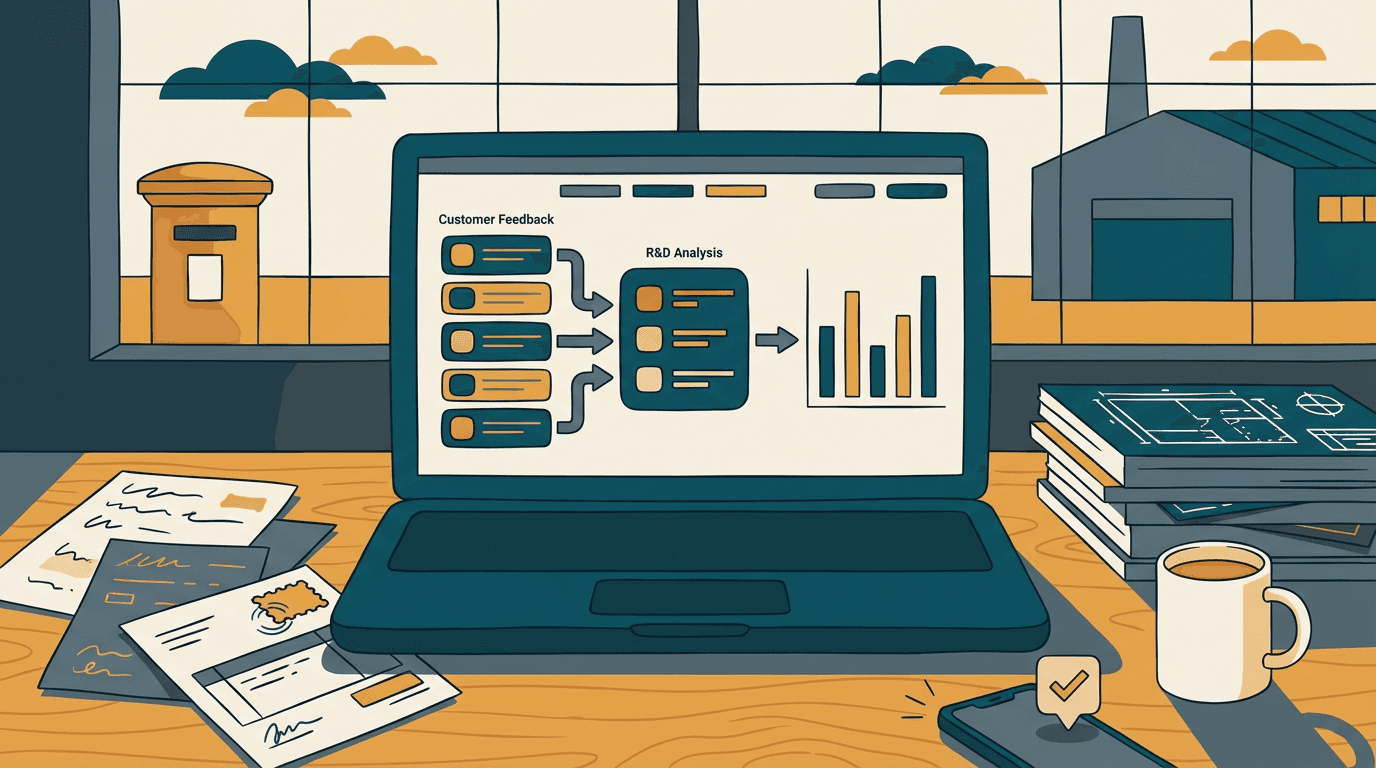
You sit down with your head of product for the morning catch-up. The Shopify return rate for your flagship outdoor jacket just ticked up to 8%.
Your ops manager thinks it is a sizing issue. Your junior analyst suspects a bad batch of zippers. But nobody actually knows.
The real answers are buried inside 400 free-text customer emails sitting in a Zendesk queue. Your team is busy guessing, while the exact engineering flaw is sitting in your own database, entirely unread.
You are flying blind. Your customers are literally telling you how to fix your product, but you do not have the human hours to read, tag, and pass those insights to the manufacturing floor. It is a mess. End of.
The unstructured R&D bottleneck
The unstructured R&D bottleneck is the structural failure where your most valuable product feedback dies in free-text support tickets because nobody has the time to read, categorise, and pass it to the engineering team.
This is not a theoretical problem. It happens in almost every physical product business that scales past £5M in revenue. You hire a customer service team to close tickets fast. Their primary metric is resolution time. They are not paid to extract R&D insights.
So, a customer writes a detailed paragraph about how the 4mm bracket on your product snaps when exposed to freezing rain. The service rep apologises, issues a £50 refund, and closes the ticket. The insight is gone.
The manufacturing team never sees it. They keep ordering the exact same 4mm bracket from the supplier. You keep paying for the refunds. Nobody connects the dots.
This disconnect is expensive. An Alibaba survey of 1,000 SME decision-makers found that 48% of UK SMEs are planning to increase their spending on product innovation and R&D. They are throwing real money at new product development. But they are building on top of a broken feedback loop.
You cannot innovate effectively if you do not know exactly why your current products fail in the field. The data already exists. It is just trapped in a format that computers historically could not read and humans do not have the hours to process. That is the unstructured R&D bottleneck. It stifles product development entirely.
Why the obvious fix fails
The most common attempt to fix this is the batch-summary trap, where companies paste hundreds of support tickets into ChatGPT once a month and ask for general themes.
This is the default move for most founders. You export a massive CSV from Zendesk. You upload it to Claude or ChatGPT. You ask the AI to tell you what customers are complaining about.
It fails every time. The mechanism of failure is how large language models weigh frequency against severity.
When you ask an LLM to summarise a massive batch of text, it looks for the most repeated phrases. If 40 people complain about DPD shipping delays, and one person writes a highly technical breakdown of a lithium battery overheating, the summary will focus entirely on the shipping delays.
The AI tells you customers want faster delivery. You already knew that. The critical engineering failure gets completely smoothed over in the summary because it only appeared once. The signal is lost in the noise.
The other popular fix is the Zapier Slack dump. You set up a Zapier automation that triggers every time a ticket is tagged product flaw. It sends the full text of the email into a dedicated Slack channel for the product team.
In my experience, when a Slack channel hits 50 raw customer emails a day, the product team mutes it within 72 hours. A product manager cannot read a wall of angry text while trying to do their actual job. The automation keeps running, but the human feedback loop is dead.
You do not need summaries. You do not need a firehose of raw text. You need structured data.
The approach that actually works

The approach that actually works is using an LLM as an inline data extractor, forcing it to read every single ticket individually and output strict JSON into a database.
You do not use AI to summarise. You use it to parse. You treat the LLM as a junior data entry clerk who reads one email at a time and fills out a highly specific form.
Here is what actually happens. A customer emails your support address: The zip on the blue jacket got stuck after I wore it in the rain twice, and the left pocket stitching is coming undone.
An n8n webhook catches that incoming email. It strips out the signature and the pleasantries. It sends the raw text to the Claude 3.5 Sonnet API.
Crucially, you do not ask Claude for its opinion. You pass it a strict JSON schema. You instruct it to extract four exact variables: component_name, failure_mode, severity_score_1_to_5, and environmental_condition.
Claude reads the email and returns a structured payload. Component: zip. Failure mode: stuck. Severity: 3. Condition: rain. It also returns a second payload for the pocket stitching.
The n8n workflow then takes that JSON and writes it directly into an Airtable base.
Now, look at what your product team has. They do not have a noisy Slack channel. They have a clean, filterable database. When it is time to redesign the jacket for next season, the head of product opens Airtable. They filter for component_name = zip and instantly see exactly how many times it failed and under what conditions.
This is how you accelerate product development. You turn unstructured complaints into a quantitative R&D database.
Building this pipeline takes 2-3 weeks of build time. It costs around £6k-£12k depending on how messy your existing Zendesk or HubSpot setup is.
The known failure mode here is schema drift. Customers will use weird terminology that your database does not expect. They will call a bracket a metal thingy. You catch this by adding an unrecognised_term field to your JSON schema. If the AI flags a term it cannot categorise, it drops it into a manual review queue in Airtable. A human looks at it once a week and updates the master component list.
Where this breaks down
This extraction pipeline breaks down entirely when your primary customer feedback channel relies on legacy voice-over-IP transcription.
If your support tickets come in as telephone calls handled by older VoIP systems like 3CX, do not build this yet. The word error rate on legacy audio transcription is too high for an LLM to reliably parse precise engineering terms.
When a customer says the zip broke, a bad transcription engine logs it as sip coke. The LLM tries to map sip coke to your product catalogue, fails, and either drops the data or hallucinations a completely new issue. Your error rate jumps from 1% to over 15%.
You need to check your data quality before committing to an extraction build. Pull 50 random tickets. Read them yourself. If a human engineer cannot confidently identify the failing component from the text alone, the AI will not be able to do it either.
Garbage in, garbage out still applies. Fix your transcription layer with a modern tool like Whisper before you try to automate your R&D data. Do not build advanced extraction on top of broken text.
Three mistakes to avoid
Avoid these three specific traps when you start building your feedback extraction pipeline.
- DON'T let the AI reply to the customer about the product flaw. This is a pure extraction exercise. The LLM is reading the text and writing to a database. Don't connect it back to your outbound email system. If a customer reports a broken bracket, you don't want an unprompted AI promising them a redesigned product next month. Keep the extraction layer completely decoupled from your customer service responses. You're building a research tool, not a chatbot.
- DON'T use generic sentiment analysis scores. Many off-the-shelf SaaS tools will offer to tag your tickets with a sentiment score from positive to negative. Ignore this. A sentiment score tells your product team absolutely nothing about how to fix the item. A polite email about a catastrophic battery failure might score as neutral sentiment, while a rude email about a late delivery scores as highly negative. Force the AI to extract physical components and failure modes, not emotions. Sentiment doesn't ship better products.
- DON'T ask the LLM to invent solutions. Your prompt should strictly forbid the AI from suggesting engineering fixes. Its only job is to categorise the problem. If you ask it for solutions, it will fill your Airtable with generic, unworkable advice like use stronger materials or make the bracket thicker. Your R&D team are the experts. Give them the structured data about the failure, and let the humans design the actual fix. The AI is your data clerk, not your lead engineer.
Get our UK AI insights.
Practical reads on AI for UK businesses — teardowns, how-to guides, regulatory news. Unsubscribe anytime.
Unsubscribe anytime.