Solving the Shadow IP Tax Through Secure AI Knowledge Retrieval
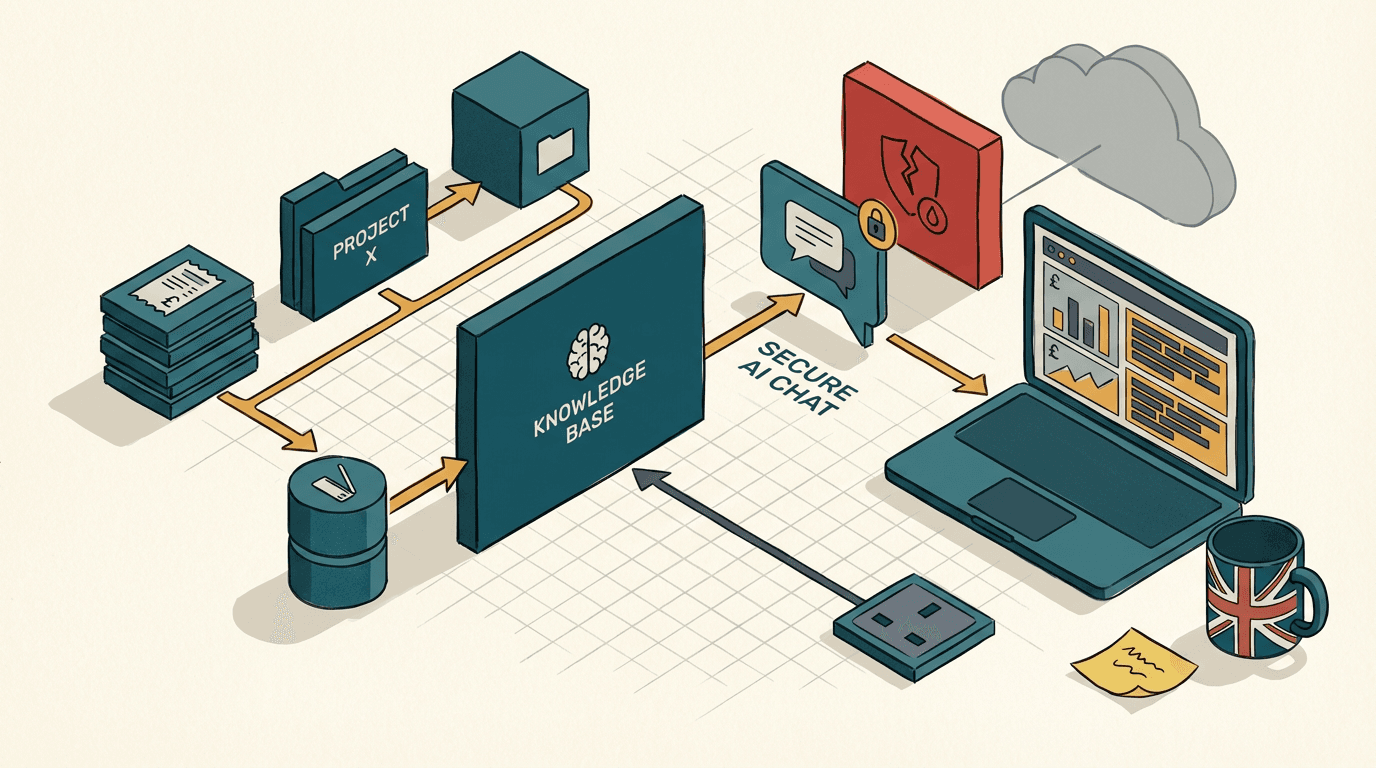
You walk onto the factory floor and see a senior production engineer staring at a loading screen. He is trying to find the torque tolerance for a 2018 pump assembly. A nested SharePoint folder hides the spec. He knows ChatGPT could extract it in four seconds. He also knows the company policy strictly forbids uploading proprietary CAD files or supplier PDFs to any AI tool.
So he clicks, waits, and searches manually. This is happening fifty times a day across your business. You're paying engineering salaries for administrative archaeology.
The market tells you to buy an enterprise AI license to fix this. But securing your data from external vendors is only half the battle. Securing it internally is where the real system gets built.
The shadow IP tax
The shadow IP tax is the invisible financial drain of your team manually hunting through legacy drives because they are barred from uploading proprietary schematics to public AI tools. It happens when your security policy outpaces your operational tooling. You lock down the data to protect your intellectual property. Your team defaults to slow, manual retrieval.
Every UK manufacturer with a decade of history has this problem. You have terabytes of supplier PDFs, maintenance logs, and ISO compliance documents. This data is your competitive advantage. But if your team can't query it instantly, it becomes dead weight.
Founders look at the £20-per-user cost of standard AI subscriptions and assume it's a cheap fix. It isn't. When you ban public AI to protect your IP, you inadvertently tax your most expensive staff. They spend hours searching instead of building.
The friction is structural. You can't just tell staff to use standard ChatGPT. If a junior analyst uploads a sensitive supplier contract to a public model, that data can become part of the training set. Your IP is gone. End of. So you block it. And the shadow IP tax quietly eats your margins.
A 50-person manufacturing firm easily loses 200 hours a month to this. That isn't just lost time. It means delayed quotes, missed tolerances, and frustrated engineers. The data sits in Microsoft 365 or an on-premise server, completely disconnected from the modern tools your team wants to use. You end up paying senior engineering salaries for administrative archaeology.
Why off-the-shelf AI subscriptions fail
Buying standard ChatGPT Plus accounts fails because a generic subscription lacks enterprise-grade data boundaries. Most SMEs try to fix their retrieval problem by upgrading to a paid tier, assuming it means private data. It doesn't.
In my experience auditing £10M manufacturing ops, the immediate reaction is to buy twenty Plus licenses. But here's the mechanism that bites you. Standard paid accounts still pool data at the user level. If an ops manager uploads a sensitive CAD export, it sits in their personal chat history. You have no visibility. You have no audit log. If they leave the company, that data leaves with them on their personal device.
Then you look at ChatGPT Enterprise. OpenAI's Trust Portal explicitly states they don't train models on Enterprise data by default. It's SOC 2 Type 2 compliant. It encrypts data at rest with AES-256. This solves the external security problem. Your data is safe from OpenAI.
But it misses the internal security problem. ChatGPT Enterprise doesn't natively understand your company's folder permissions out of the box. If you connect it to your central database, it indexes everything. Suddenly, a junior sales rep can ask the AI for the MD's salary or the exact margin on a sensitive defense contract.
The AI will happily summarize it. The contrarian truth is that external data leakage is a solved problem. Internal data overexposure is the real threat. Off-the-shelf tools strip away the access control lists you spent years building. They flatten your permissions. And that's why your IT lead rightly blocks the rollout. You fix the external leak, but you create an internal flood.
The secure retrieval architecture

A secure retrieval architecture connects an enterprise AI directly to your existing access controls so it only surfaces documents the user is already allowed to see. This is where the newly updated Amazon Q Business steps in, and how it differs operationally from a standalone ChatGPT Enterprise setup.
Let's walk through a real build. A maintenance engineer needs the exact calibration steps for a hydraulic press from a 2021 supplier manual. The manual lives in a restricted SharePoint folder.
If you use Amazon Q Business, the architecture is native. Amazon Q connects directly to your Microsoft 365 environment using a built-in connector. It ingests the PDFs, but crucially, it also ingests the Access Control Lists. When the engineer types their query, Amazon Q checks their IAM identity against the SharePoint permissions at runtime. If they don't have access to the folder, the AI pretends the document doesn't exist.
If you build this with ChatGPT Enterprise, you have to engineer the permissions yourself. You use an n8n webhook to trigger a strict API call. The user asks a question in a custom GPT. The GPT fires an action to your server. Your server runs a script to check the user's Entra ID group. If approved, it runs a retrieval-augmented generation search against a vector database like Supabase, grabs the text, and returns it to the chat.
The Amazon Q route is faster to deploy for Microsoft-heavy UK manufacturers. Following the AWS re:Invent 2025 updates, Q's reasoning engine is sharp enough to parse dense manufacturing tables. It can read a 50-page maintenance manual and extract the exact calibration steps without hallucinating the numbers. You face 2-3 weeks of build time. The cost runs between £6k and £12k depending on how messy your existing SharePoint or S3 permissions are.
If you go the ChatGPT Enterprise route, you get a slightly more flexible chat interface, but you pay for it in build complexity. You have to maintain the middleware. When OpenAI updates their API, your n8n workflows might need tweaking. When a user changes departments, you must ensure Entra ID syncs perfectly with your vector database access rules.
The primary failure mode here is garbage in, garbage out. If your SharePoint permissions are already a mess, Amazon Q will expose that mess instantly. We catch this by running a dry-run audit on folder access before ever connecting the AI. You must clean your house before you invite the robot inside. Once clean, the shadow IP tax vanishes.
Where this breaks down
This architecture fails completely if your historical data relies on scanned images or proprietary 3D formats. It relies entirely on machine-readable text and structured permissions. If your data environment runs on archaic systems, this build will hit a hard wall.
If your invoices and supplier specs come in as scanned TIFFs from a legacy ERP like Sage 50 on-premise, you have a problem. Amazon Q and ChatGPT Enterprise both struggle to index raw image files buried in local network drives. You need an OCR pipeline first. Once you introduce OCR, the error rate jumps from 1% to roughly 12%. A misread decimal in a torque tolerance is a catastrophic failure in manufacturing ops.
You also hit a wall with proprietary CAD formats. These AI models read text, not 3D geometry. If your engineers need to query the dimensions inside a native SolidWorks file, a standard text-based AI can't help them. It skips the file entirely.
Before committing to a build, you must audit your data formats. If 80% of your critical knowledge is locked in scanned images, handwritten maintenance logs, or proprietary CAD files, don't buy an enterprise AI license yet. Fix your data ingestion first. Otherwise, you're just paying for a very expensive search bar that returns zero results.
Three mistakes to avoid
Don't let the hype rush you into a bad deployment. When securing your knowledge retrieval, watch out for these traps.
- DON'T ignore your existing folder permissions. Avoid connecting any AI tool to your root directory without checking who has access to what. If you sync your entire Google Workspace or Microsoft 365 environment to an AI, you'll accidentally expose HR records and executive compensation to the whole company. Always run a permissions audit first. If your folders are a free-for-all, the AI will be too.
- DON'T assume a paid subscription guarantees privacy. Avoid buying standard SaaS tiers and assuming your IP is safe. A £20 monthly plan usually still allows the vendor to train on your inputs. You must use enterprise tiers like ChatGPT Enterprise or Amazon Q Business, and you must verify their data retention policies. Check the SOC 2 reports. If you don't own the inputs and outputs, you're giving away your competitive advantage.
- DON'T force engineers to use clunky interfaces. Avoid building a secure system that is so hard to access that your team bypasses it. If they have to log into a separate VPN, authenticate three times, and use a slow web portal, they'll just go back to manual searching. The tool must live where they work. Integrate it into Teams, Slack, or their primary workstation. If the secure way isn't the easiest way, the shadow IP tax will return immediately.
Get our UK AI insights.
Practical reads on AI for UK businesses — teardowns, how-to guides, regulatory news. Unsubscribe anytime.
Unsubscribe anytime.