The Shadow AI Tax: Why Banning Public AI Tools Fails UK SMEs
Walk through your open-plan office right now and look at the browser tabs. Your ops manager has a personal ChatGPT Plus tab pinned. Your junior analyst is pasting client financial data into Claude to format a report. Your sales rep is using a free AI transcription tool on a Zoom call with your biggest account.
You don't pay for these subscriptions. You don't have policies for them. But your company is already running on them.
This is the reality of UK SMEs right now. Your team is buying their own AI tools, expensing them as software, and feeding them your proprietary data. You think you are waiting to adopt AI. Your staff adopted it six months ago.
The shadow AI tax
The shadow AI tax is the compounding cost of unmanaged, employee-purchased AI subscriptions silently processing your company data without oversight.
It happens because your team is trying to work faster, not because they want to steal data. They hit a wall with manual data entry in Xero or HubSpot. They realise a £16-a-month Claude subscription can write their emails and format their spreadsheets. They buy it. They use it.
You only find out when something breaks.
The Edinburgh Futures Institute recently launched a responsible AI course to help UK SMEs bridge the AI trust gap, and their research hits the nail on the head. They found that employees are already using AI tools at work without their employers' knowledge, permission, or oversight [source](https://efi.ed.ac.uk/responsible-ai-course-to-help-uk-smes-bridge-the-ai-trust-gap/).
This creates a massive liability. When a junior bookkeeper pastes a supplier's invoice into a public LLM to extract line items, that data trains the public model. If that invoice contains personal identifiable information, you just breached GDPR.
But the tax isn't just compliance risk. It is operational chaos.
You end up with five different departments using five different AI tools to do the exact same thing. Nobody shares prompts. Nobody standardises the output. When the person who built the clever ChatGPT workaround goes on holiday, the entire workflow stops.
The business doesn't own the process. The individual employee owns it. If they leave, the capability leaves with them, and you are left paying the subscription for an empty seat.
That's a fragile way to run a £5M business.
Banning public AI tools drives the behaviour underground
Banning public AI tools drives the behaviour underground because it removes the symptom without solving the underlying operational bottleneck.
The standard SME reaction to discovering unmanaged AI is a blanket ban. The MD sends an email. IT blocks ChatGPT on the company network. You buy a generic, off-the-shelf enterprise AI wrapper for £30 a seat and tell everyone to use that instead.
Here is what actually happens.
Your staff just switch to their personal phones. They tether their laptops to bypass the network block. They keep using the tools that actually work for their specific tasks, and they stop telling you about it. You lose all visibility into where your client data is going.
The contrarian truth is that generic enterprise AI wrappers are practically useless for real operations. They are just chatbots with a corporate logo slapped on top. They don't talk to your database. They don't trigger actions in your CRM.
Let's look at the mechanics of why this fails.
Say your accounts assistant spends 15 hours a week manually reconciling Stripe payouts against Xero invoices. You give them a locked-down corporate AI chatbot. What can they do with it? They can ask it how to use Xero. They can ask it to write a polite email to a supplier.
But the chatbot can't fetch the Stripe JSON payload. It can't parse the nested fee structures. It can't authenticate with the Xero API to match the transaction.
The underlying bottleneck remains untouched. The employee is still doing 15 hours of manual data entry.
In my experience reviewing SME ops, companies waste an average of £4,000 to £8,000 a year on generic AI SaaS seats that nobody logs into after the first week. The tools don't solve the hard, messy, structural problems of moving data between systems.
So the employee goes back to their personal Zapier account and their personal OpenAI API key, building fragile, unmanaged workarounds just to survive the month-end close. The ban achieves nothing. It just blinds you to the risk.
The BRAID framework replaces shadow tools with managed operational pipelines

The BRAID framework replaces shadow tools with managed operational pipelines by routing all AI requests through a central, authenticated hub that you control.
You don't want employees pasting data into public browser tabs. You want system-to-system automation that uses AI as a processing engine, not a chat interface. The Edinburgh Futures Institute developed the BRAID programme to help businesses make grounded decisions about AI design [source](https://efi.ed.ac.uk/responsible-ai-course-to-help-uk-smes-bridge-the-ai-trust-gap/). The practical application of this for an SME is building a managed pipeline.
Here is a worked example of how you actually do this for invoice processing.
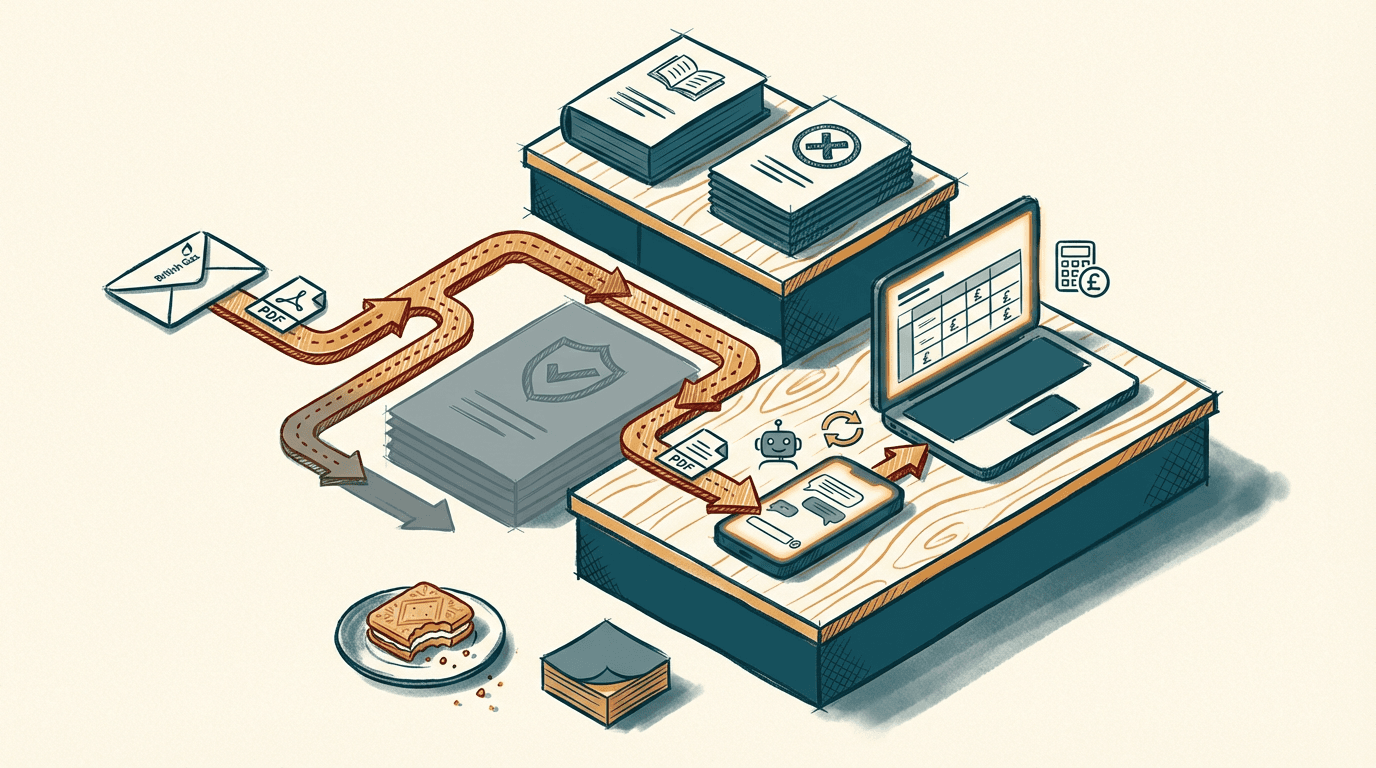
Your supplier emails a PDF invoice to a shared Outlook inbox. Instead of a human downloading it and pasting it into Claude, you build a deterministic flow.
First, you use Make to watch the Outlook inbox for attachments. When an email lands, Make grabs the PDF and sends it to a secure, enterprise-tier Claude API endpoint. Because you are using the API, your data is explicitly excluded from future model training.
Pay attention to this part. You don't just ask Claude to read the invoice. You pass a strict JSON schema in the API call. You tell the model exactly what keys to return: invoice number, date, supplier name, net amount, VAT amount, and an array of line items.
Claude processes the PDF and returns a perfectly formatted JSON object.
Make receives this JSON. It then uses the Xero API to search for the supplier. If the supplier exists, Make sends a POST request to create a draft bill in Xero, mapping the JSON fields directly to the Xero line items.
The human only steps in at the very end to click Approve in Xero. The entire reconciliation process drops from 15 hours a week to 15 minutes.
This is how you eliminate the shadow AI tax. The employee doesn't need a personal AI subscription because the system does the heavy lifting automatically. The data never leaks to public training models because you are using a zero-retention commercial API.
Building this specific pipeline takes about 2 to 3 weeks. You should expect to spend £5,000 to £9,000 on the initial build, depending on how messy your supplier data is. The ongoing API costs are pennies per invoice.
The main failure mode here is hallucination on edge cases. If a supplier sends a pro-forma invoice with a weird layout, the LLM might extract the wrong total.
You catch this by adding a validation step in Make. If the sum of the line items doesn't match the total amount, Make halts the flow and sends a Slack message to your ops manager with a link to the PDF.
The system fails safely. It stops. It alerts a human. It doesn't silently write bad data to your ledger.
AI pipelines fail on unstructured legacy formats
AI pipelines fail on unstructured legacy formats because large language models cannot reliably parse degraded visual data without a dedicated optical character recognition layer.
This approach isn't magic. It requires a baseline level of digital hygiene. If you try to force messy, analogue processes through a strict API pipeline, the system will reject the data and your ops team will spend all day clearing error logs.
If your suppliers send crisp, digitally generated PDFs from QuickBooks or Shopify, the Claude API will extract the data with near-perfect accuracy. The JSON schema sticks. The pipeline flows.
But if your business relies on handwritten delivery notes, or invoices that have been printed, scanned, faxed, and scanned again as grainy TIFF files, this system will break.
I see this constantly in logistics and construction. You feed a blurry, skewed scan into an LLM vision model. The error rate jumps from 1% to 15%. The model hallucinates an extra zero on a line item. The validation step catches it, but if 15% of your volume requires human intervention, the automation loses its value.
Before you commit £8,000 to building an AI pipeline, audit your inputs.
Look at the last 100 documents your team processed. If more than 10% are illegible or handwritten, don't start with an LLM. You need a dedicated OCR tool first to clean and digitise the text. Only then can you route it to the AI for extraction. Build the foundation before you build the engine.
The push for responsible AI isn't about writing a corporate policy document that sits in a Google Drive folder gathering dust. It is about looking at the raw mechanics of how your business operates and fixing the underlying friction that drives your staff to use unmanaged tools in the first place. A blanket ban won't protect your data. A generic chatbot won't reconcile your accounts. The only way to regain control is to build deterministic, API-driven pipelines that do the heavy lifting safely, quietly, and accurately. The question isn't whether your team will use AI to do their jobs. They already are. The question is whether you are going to keep ignoring the risk, or whether you are finally going to build a system that turns that rogue behaviour into a managed, permanent asset.
Get our UK AI insights.
Practical reads on AI for UK businesses — teardowns, how-to guides, regulatory news. Unsubscribe anytime.
Unsubscribe anytime.