The Passive IP Leak: Why LinkedIn AI Defaults are Draining Your SME's Strategy
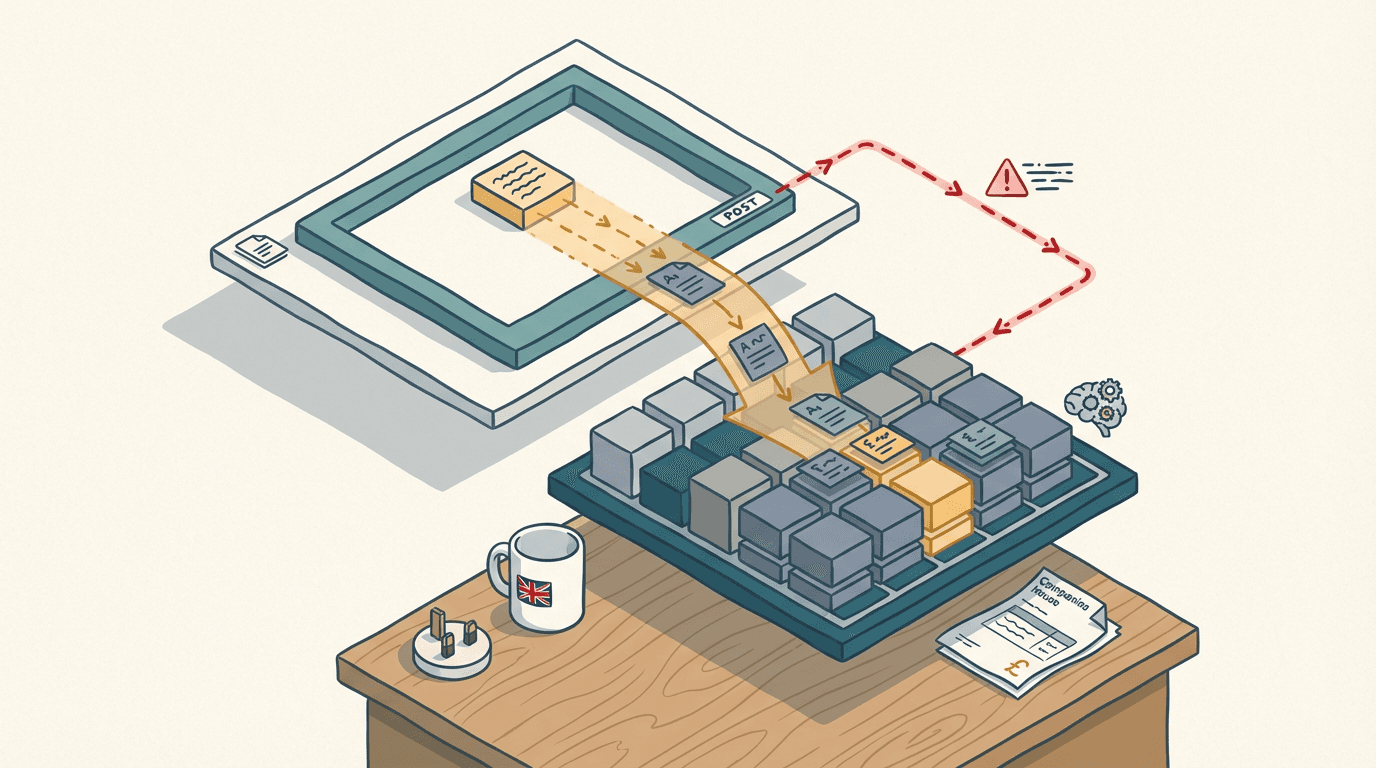
Your ops manager just published a brilliant breakdown on LinkedIn. They detailed exactly how your team cut client onboarding time in half. They named the specific software stack. They explained the custom workaround your lead developer spent three weeks building.
They hit post, feeling proud. They think they are building their personal brand.
Here is what actually happens. That post bypasses your internal security protocols and feeds directly into Microsoft's AI training pipeline.
Since late 2025, LinkedIn defaults to scraping user data for generative AI models unless users manually dig through their settings to opt out.
Your team is handing over your proprietary operational playbook to a public machine learning model. Free of charge. And you are probably encouraging them to do it.
The passive IP leak
The passive IP leak is the continuous, unmanaged transfer of your company's proprietary methods into public AI models via your employees' default social media settings.
It happens quietly. You do not see a massive data breach alert. There is no hacker in a hoodie. It is just your best people doing exactly what every marketing guru tells them to do. They build in public. They share playbooks, templates, and operational wins to attract talent or clients.
But the rules of the platform changed. In late 2025, LinkedIn updated its privacy policy to use member data by default for training its generative AI models. This includes posts, articles, and profile data. If your team operates in the UK or EU, they are opted in automatically.
This is a structural problem for SMEs. Enterprise companies have patents and massive legal teams to protect their intellectual property. Your SME does not. Your competitive advantage is your process. It is the specific way you string together Xero, HubSpot, and a custom database to deliver faster than the big guys.
When your team posts the exact details of that process, LinkedIn's models absorb it. Definition Consulting highlights a brutal reality here. Competitors using AI-powered tools can now theoretically emulate your brand voice or extract your market approach directly from this aggregated data.
The leak persists because it feels like marketing. Founders actively applaud when their staff post deep-dive operational content. You reward the engagement. You do not realise you are subsidising the training data for tools your competitors will buy next year.
Why the obvious fix fails
Manual HR policies and generic social media guidelines fail because they rely on human compliance to fight an automated, platform-level data ingestion engine.
What do most SMEs try first? They call an all-hands meeting. HR sends a company-wide email. The message is simple. Please go into your LinkedIn settings, navigate to Data Privacy, and toggle off the Data for Generative AI Improvement option. Or worse, they write a 14-page policy document, drop it into a Google Workspace shared drive, and ask everyone to sign it.
Here is the exact mechanism of why the manual opt-out fails.
First, LinkedIn's user interface changes constantly. The toggle moves. A junior analyst tries to find it, gets distracted by a Slack notification, and gives up.
Second, even if every single employee toggles it off today, it only stops future data collection. The platform explicitly states that opting out does not retract data already scraped and processed.
And yes, that's annoying.
But the deeper failure is the policy document approach. A written policy assumes the risk is reputational. It assumes an employee might swear or insult a client. It fundamentally misunderstands the technology. The risk is now algorithmic.
If you try to bypass this by mandating that all posts go through a scheduling tool like Buffer or HubSpot, you miss the point entirely. The scheduling tool pushes the text to the LinkedIn API. Once the JSON payload hits LinkedIn's servers, the platform's terms of service claim that text for training.
You cannot policy your way out of a platform-level data scrape. I often see founders assume their IP is safe just because they have a signed PDF in a personnel file. That PDF does not stop a web scraper. Relying on your staff to manually manage their privacy settings across every platform they use for work is a losing battle. It breaks down the moment you hire a new person who forgets to click the toggle.
The approach that actually works

The only reliable way to protect your operational data is to build an automated sanitisation layer that strips proprietary mechanics from text before it reaches the internet.
You do not stop your team from posting. You intercept the draft. Here is what actually happens in a working system.
Let's say your ops lead wants to write a post about a recent win. They managed to automate a messy reconciliation process between Stripe, a legacy 3PL provider, and Xero. The raw draft includes the exact API endpoints they hit, the specific Zapier limitations they bypassed, and the exact volume of transactions processed last month.
If they post that directly, the passive IP leak strikes.
Instead, they drop their draft into a dedicated Slack channel called #content-review. This triggers a webhook in Make.com. The Make scenario picks up the text and fires it to the Claude 3.5 Sonnet API.
Pay attention to this part. The system prompt sent to Claude is strict. You are a corporate IP protection filter. Review the following LinkedIn post draft. Identify and redact specific vendor names, exact revenue numbers, custom code references, and proprietary workflow steps. Rewrite the post to maintain the core leadership insight and tone, but generalise the operational mechanics. Return only the sanitised text.
Claude processes the draft. It changes We bypassed Zapier's 2-minute timeout by routing the Stripe JSON through a custom Supabase edge function to handle the £2.4M volume to We rebuilt our payment routing to handle high-volume transactions asynchronously, completely eliminating middleware timeouts.
The Make scenario catches Claude's output. It posts it back into the Slack channel as a threaded reply, tagging the ops lead.
They click a green Approve button if it looks good, or a red Regenerate button if Claude made it sound too robotic. Only after they click approve does Make.com push the final text to the LinkedIn API.
You can build this entire flow in Make or n8n. It takes roughly one to two weeks of build time and testing. Expect to spend £2,000 to £4,000 in setup, plus a negligible £10 to £20 a month in API costs for Claude and Make.
The main failure mode here is over-sanitisation. AI models love to strip out the human edge. If you aren't careful, every post starts sounding like a corporate press release. You catch this by keeping the human in the loop. The Slack approval step is mandatory. The automation does the heavy lifting of IP redaction, but the human retains editorial control.
Where this breaks down
This automated sanitisation layer breaks down entirely if your business model relies on demonstrating hyper-specific technical authority to win clients.
This approach is highly effective for general operations, finance, and sales teams. But if you run a bespoke engineering consultancy, a boutique cybersecurity firm, or a highly specialised data architecture agency, the specific technical details are the marketing.
Your clients hire you precisely because you know how to configure a niche AWS instance or patch a specific zero-day vulnerability. If you run those posts through a redaction prompt, you destroy the value. Generalising We patched CVE-2026-1234 using a custom rust binary into We solved a security issue using modern programming makes your experts look like amateurs.
Before you build this, you need to audit your marketing strategy. If your sales pipeline depends on proving you know the exact code snippet or the exact financial model, you cannot use an automated sanitiser.
You have to accept the data ingestion as a pure cost of customer acquisition. You let the models train on your data, knowing that the immediate lead generation outweighs the long-term risk of a competitor copying your homework.
Three questions to sit with
The rules of digital visibility have fundamentally shifted over the last year. You are no longer just broadcasting your wins to potential buyers and new hires. You are actively feeding the data engines that will eventually power your competitors' tools. Before you approve another internal push for your team to build their personal brands online, take a hard look at the exact information leaving your building.
- Do you know exactly which of your key employees are currently opted into LinkedIn's generative AI training data right now, and what specific operational details they have published this quarter?
- If your biggest competitor prompted a public AI model to reconstruct your proprietary client onboarding process based solely on your team's historical social media posts, how dangerously accurate would that generated output be?
- Does your current company social media policy actually address the technical mechanics of platform-level API scraping, or does it merely exist as a legacy HR document that tells people to be polite online?
Get our UK AI insights.
Practical reads on AI for UK businesses — teardowns, how-to guides, regulatory news. Unsubscribe anytime.
Unsubscribe anytime.