Why You Are Paying Your Ops Manager to Be a Human API
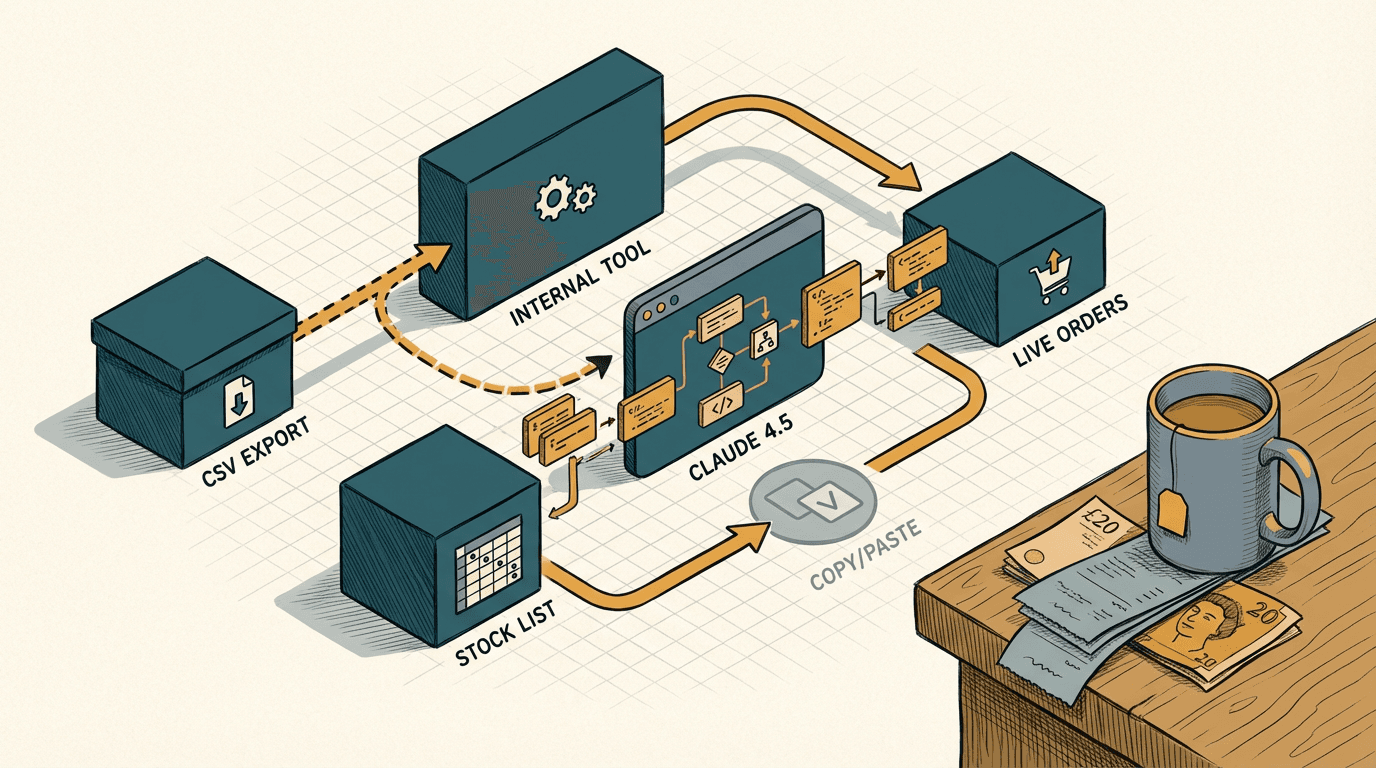
You are standing behind your ops manager's desk. You watch her open an email, download a PDF attachment, and manually copy-paste line items into Xero. She does this 40 times a day.
She earns £35,000 a year. You are paying her to be a human API.
You've probably read the articles about AI coding agents and rapid prototyping. You might have even bought a few ChatGPT subscriptions for the team. But nothing changed. The PDFs still arrive, and the manual data entry still happens.
There's a massive disconnect between the AI demos you see online and the reality of running a £5M supply chain business. The demos show code being written in seconds. The reality is your team fighting with a shared inbox.
Here's what actually works.
The £40k reconciliation tax
The £40k reconciliation tax is the hidden cost of paying a human to bridge the gap between two software systems that refuse to talk to each other. It's the salary of your ops manager, spent entirely on moving data from a supplier PDF into Xero.
Nobody sets out to build a business this way. You start with one supplier. Then ten. Then fifty.
Suddenly, your most competent team member spends three days a month downloading attachments from Outlook. They manually check Shopify order numbers against Stripe payouts. They type line items into QuickBooks. They cross-reference Pipedrive deals with the actual cash that landed in the bank.
It's a mess. Nobody knows why. End of.
The structural issue here is that traditional APIs are rigid. They demand perfect data. If a logistics partner changes their invoice layout, or adds a new row for fuel surcharges, a standard integration breaks. The code throws an error and stops.
So you throw human labour at it. You pay a premium for a human brain to do the work of a script, simply because the script can't handle ambiguity. Your ops manager isn't doing high-value work. They are just acting as a very expensive translation layer between two dumb databases.
This tax scales linearly. As your revenue grows, your paperwork grows. You hire a junior analyst. Then an accounts assistant. You aren't scaling your output. You are just scaling your overhead to keep the systems from collapsing.
Why Zapier and ChatGPT subscriptions fail
Zapier fails because it cannot handle unstructured data, and ChatGPT fails because it cannot reliably format structured outputs. Most SMEs try to fix their operations by buying ChatGPT Plus accounts for the team or stringing together Zapier flows. It feels like progress. It isn't.
Zapier works beautifully for linear, predictable data. But B2B operations are never predictable.
Here's what actually happens. You build a Zapier flow to parse incoming emails. Zapier's Find steps can't nest. So when your supplier in Xero has a custom contact field two levels deep, the automation silently writes null. You only notice at month-end when the VAT return is due.
And yes, that's annoying. But the ChatGPT route is worse.
A £25 a month ChatGPT subscription cannot replace a £35k salary, and here's the mechanism. Your accounts assistant isn't just reading text. They're applying business logic. They know that if Delivery is on the invoice from Supplier A, it goes to cost code 400. If it's from Supplier B, it goes to 401. They know which clients have special payment terms.
ChatGPT in a browser window forgets this context. It gets confused by a multi-page PDF. It hallucinate a tax code. In my experience, once you process more than 40 invoices a week, these off-the-shelf AI setups drop roughly 12 percent of your custom line items.
They fail because they lack state, memory, and strict output schemas. You're asking a conversational chatbot to do structural data engineering. The minute a user has to copy a prompt, paste it into a chat window, upload a file, and manually copy the result back into HubSpot, you haven't automated anything. You've just added more steps to the £40k reconciliation tax.
Building with Claude 4.5 Opus

Rapid prototyping with Anthropic's Claude 4.5 Opus works because the model handles ambiguity like a human while outputting structured data like a script. Here's a worked example. You receive a messy, unstructured PDF invoice from a logistics supplier. It has merged cells, weird column headers, and a fuel surcharge buried in the footer.
Not Zapier. n8n. An n8n webhook triggers when the email hits a specific Gmail inbox. n8n extracts the PDF and passes it directly to the Claude 4.5 Opus API.
Pay attention to this part. You don't just ask Claude to read the invoice. You pass Claude a strict JSON schema. You tell it exactly what fields Xero expects. You define the array of line items, the tax rate strings, and the supplier contact IDs. You include your specific business rules in the system prompt.
Claude uses its 200,000-token context window to read the entire document. It applies your logic. It ignores the promotional banner at the top of the PDF. It ignores the terms and conditions at the bottom. It returns a perfectly formatted JSON object containing only the data you requested.
n8n then takes that JSON and PATCHes the Xero invoice line items directly. No human touches it. The data moves from an unstructured email to a structured database entry in about four seconds.
This works because Claude 4.5 Opus is fundamentally different from earlier models. Anthropic dropped the price to $5 per million input tokens, making it cheap enough to run on every single email. More importantly, it scores 80.9 percent on the SWE-bench Verified coding benchmark. It understands strict data structures. It doesn't output conversational filler. It just does the work.
If you hire a developer to build this, expect 2-3 weeks of build time. It'll cost £6k-£12k depending on your existing integrations. You are paying for the plumbing, not the AI.
But you have to catch the failure modes. Claude might occasionally hallucinate a date format if the supplier uses American formatting. You fix this by adding a validation node in n8n. If the parsed VAT doesn't match the subtotal, n8n skips the Xero push and sends a Slack message to your ops manager.
The human only steps in when the bot flags an anomaly. You've inverted the workflow. Your team manages the exceptions, not the baseline process.
Where this breaks down
This approach breaks down immediately if your input data requires optical character recognition or if your destination software lacks a modern API. This system is powerful. It isn't magic.
Before you start building, you need to check your inputs. If your invoices come in as scanned TIFFs from legacy accounting software, you need an OCR step first. Once you rely on OCR, the error rate jumps from 1 percent to roughly 12 percent.
Claude 4.5 Opus can't read a smudge. If a human can't read the scan, the API will guess. And guessing in accounting is how you get fired.
You also need clean API access. If you use a niche ERP system from 2008 that only exports CSV files via an FTP server, don't try to wire an AI agent into it. The integration will break every time the server restarts. You will spend more time debugging the connection than you ever spent doing manual data entry.
Another trap is complex multi-system state. If approving an invoice requires checking a Slack thread, a Notion document, and a physical delivery receipt, the context window gets too noisy. Claude 4.5 Opus is brilliant at mapping unstructured data to structured schemas. It's terrible at chasing your warehouse manager for a signature.
Fix your plumbing first. Standardise your internal comms. Move your data into systems that have documented REST APIs. Only then should you introduce intelligence.
The question isn't whether AI replaces your ops manager. It's whether you know which £32k of her week is actually reconciling Xero against Stripe, because that's the only part a bot can touch this year. You don't need to wait for a magic SaaS product to solve this. The primitives are already here. Claude 4.5 Opus gives you the reasoning engine, and n8n gives you the hands. You just have to wire them together. Stop buying generic subscriptions hoping your team will figure it out. Start mapping the exact data flows that drain your payroll, and build the specific internal tools to automate them.
Get our UK AI insights.
Practical reads on AI for UK businesses — teardowns, how-to guides, regulatory news. Unsubscribe anytime.
Unsubscribe anytime.