The Onboarding Data Tax: How SMEs Can Automate Supplier Management
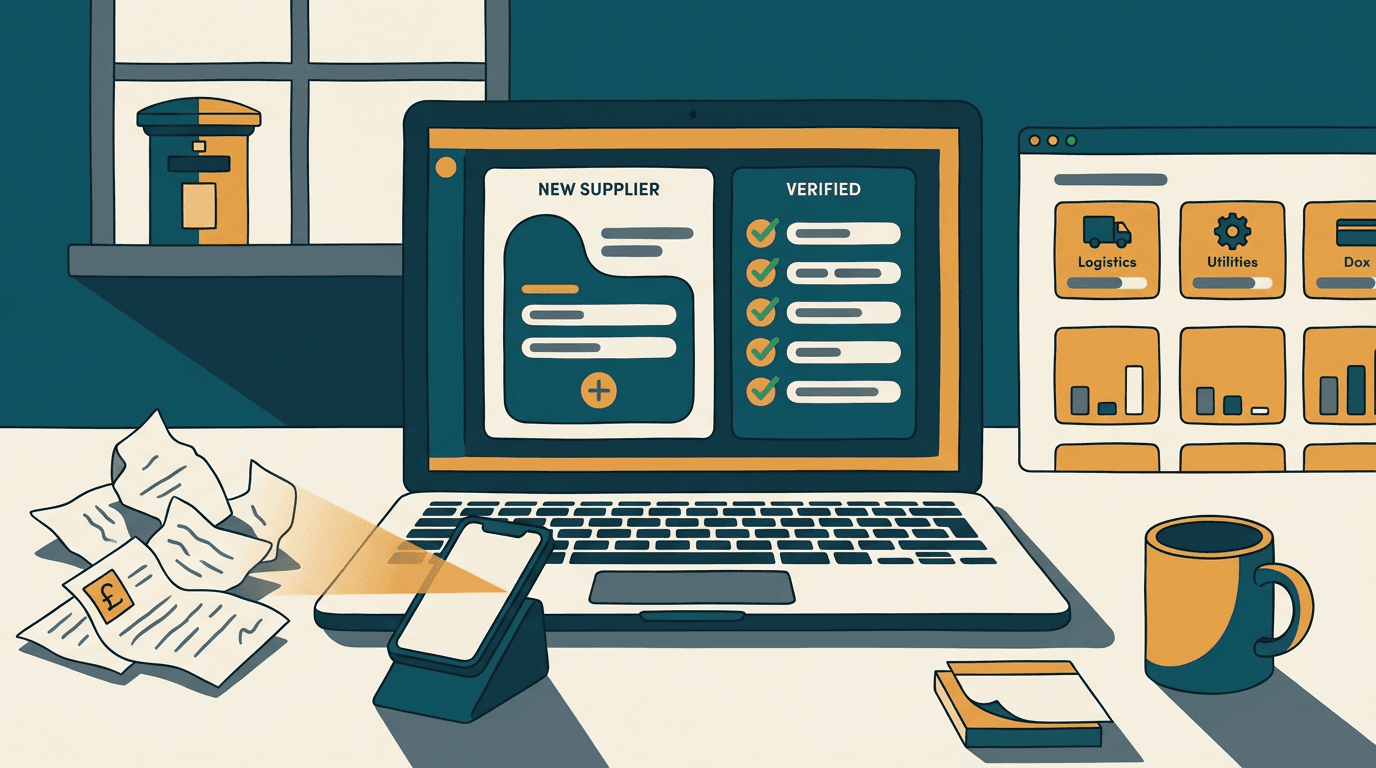
Your ops manager is staring at a PDF from a new supplier. The supplier filled out the banking details but left the tax reference blank. Now begins the email ping-pong. Outlook to request the missing number. A manual check against Companies House. A copy-paste job into Xero.
A Slack message to the finance director to approve the new payee. This is how supplier onboarding happens in almost every SME. It's slow, error-prone, and soul-crushing. You're paying a smart person £35,000 a year to act as a human router between a PDF and an accounting system.
When a business scales, this manual routing breaks. The backlog grows. Payments get delayed. Suppliers get annoyed. You start looking for a way to automate it.
The onboarding data tax
The onboarding data tax is the hidden margin you lose to manually extracting, verifying, and entering vendor details across disjointed systems before a single invoice can be paid. It happens because SMEs lack the £50k budget for enterprise procurement software. Instead, they rely on a fragile patchwork of emails, PDFs, and spreadsheets.
This tax compounds with every new vendor. Your team asks for a W-8BEN or a UK VAT certificate. The vendor replies three days later with a blurry JPEG or a password-protected zip file. Someone has to open that file, read the image, decide if the document is valid, and type the numbers into Xero.
It affects everyone in the chain. Finance waits for verified bank details. Operations waits to place the order. The supplier waits to get paid. The business bleeds time. The process is entirely predictable, yet treated like a bespoke event every single time.
There is also a massive security blind spot. When an accounts assistant is rushing to clear a backlog of twenty suppliers, they stop checking the details closely. They miss the subtle difference in a sort code that signals invoice fraud.
The Bospar data on supply chain AI highlights that supply chain cyberattacks jumped 431% between 2021 and 2023. A manual, rushed onboarding process is exactly how bad actors slip through the cracks.
Most founders ignore this tax until they hit a growth phase. Suddenly, adding twenty suppliers a month requires a dedicated accounts assistant. You're throwing payroll at a data routing problem. That is when people start Googling for supply chain AI and vendor management tools.
But the reality of adoption is bleak. The same Bospar data shows that while 90% of companies use AI somewhere, adoption in supply chain and inventory management sits at just 12%. Procurement is dead last. The enterprise players are building massive data lakes. The SMEs are just trying to read a PDF without crying.
Why the obvious fix fails
The obvious fix of linking a Google Form to Zapier fails because supplier onboarding is an unstructured negotiation, not a clean data entry task. You send the supplier a link. They fill in their details. Zapier catches the webhook and pushes the data into Xero. It sounds perfect. It's also completely detached from reality.
Suppliers hate your forms. They won't fill out a 40-field questionnaire just to sell you £500 of materials. They will reply to your email with a generic company PDF and a polite note telling you to find the details there. Your Zapier flow starves because it expects structured inputs.
So, you try adding AI. You set up a Make scenario that sends the PDF to a basic ChatGPT Plus subscription. This is where the mechanism breaks down. Standard ChatGPT calls are non-deterministic. They hallucinate structure.
When the OpenAI API reads a complex supplier application, it might extract the trading name but miss the legal entity name. Zapier's mapping steps can't nest complex logic easily.
If your Xero supplier contact requires a specific tax format and ChatGPT outputs a conversational string like 'The VAT number is GB123456789', the automation silently writes a null value or fails validation. You only find out when a payment bounces two weeks later.
Zapier's Find steps can't nest deeply enough to handle the chaos of B2B documents. When your Xero supplier has a custom contact field two levels deep, the automation simply skips it if the AI output is slightly misaligned.
The fundamental error is treating vendor management as a simple data transfer. It isn't. It's a validation exercise. An off-the-shelf automation tool assumes the data is correct once extracted. It doesn't check Companies House. It doesn't verify the VAT number format.
What I see repeatedly is a founder spending a weekend building a Zapier web of logic jumps. It works for one perfect test case. Then a real supplier sends an email with a password-protected ZIP file, and the entire automation silently dies in the background.
A £25/month ChatGPT subscription can't replace a £35k salary, and the inability to handle edge cases is exactly why.
The approach that actually works

To automate supplier onboarding properly, you need an orchestration layer that handles unstructured documents and strict API validation. You don't need enterprise software. You need n8n, Claude, and a clear set of business rules.
Here is the exact architecture. A supplier emails their onboarding pack to a dedicated Outlook inbox. An n8n webhook triggers on the new email. It strips the attachments, converts them to text using a lightweight parser, and sends them to the Claude 3.5 Sonnet API.
This is the crucial part. You don't just ask Claude to 'extract details'. You use a strict JSON schema. You tell the model exactly what fields you need: legal name, registered address, VAT number, and bank sort code.
If the PDF is missing the VAT number, the JSON schema forces Claude to return a null value. It prevents the model from guessing.
Once n8n receives the JSON, it runs a validation branch. It takes the company registration number and pings the Companies House API. It checks the VAT number against the HMRC database.
If anything mismatches, say, the trading name on the PDF doesn't match the registered entity, n8n drafts an email back to the supplier, pointing out the exact discrepancy, and leaves it in your ops manager's drafts folder.
If the data is perfect, n8n makes a POST request to the Xero API. It creates the contact, sets the default tax rates, and fills in the banking details. It handles the OAuth2 token refresh automatically, a detail Zapier often fumbles.
Finally, it sends a Slack message to the finance channel: 'Supplier X onboarded. Ready for approval.' This is how AI procurement actually functions on an SME budget. You are building a deterministic wrapper around a non-deterministic model. The AI handles the messy extraction. The hard-coded APIs handle the truth.
Building this takes about two to three weeks. Expect to spend £6,000 to £12,000 depending on how messy your current Xero setup is and whether you need to integrate with a CRM like HubSpot or Pipedrive alongside it.
The ongoing software cost is negligible. You pay for n8n hosting and a few dollars a month in Claude API tokens.
The failure modes are predictable. A supplier sends a scanned TIFF file from a 1990s fax machine. Claude struggles to read it. To catch this, you add a routing rule. If the AI confidence score drops below a certain threshold, the system flags a human in Slack. You manage the exceptions, not the baseline.
Where this breaks down
This automation architecture breaks down when it hits legacy ERP systems that lack modern APIs, or when supplier vetting requires qualitative human judgement. If your business runs on a legacy ERP that requires flat-file CSV uploads via an FTP server, this approach gets messy fast.
You end up building fragile middleware to bridge the gap between a modern webhook and a system built in 2004.
It also breaks down if your supplier vetting requires qualitative judgement. If your onboarding process involves a human reading a modern slavery statement and deciding if it meets your internal standards, an LLM can't sign off on that risk.
You can extract the text, but you can't automate the liability. A bot can't take legal responsibility for compliance.
Volume matters too. If you only onboard two suppliers a month, spending £8,000 to build an automated pipeline is a waste of capital. The onboarding data tax only hurts when the volume scales to a point where it disrupts your core operations.
Before you commit to building this, audit your last twenty supplier onboardings. Look at the formats they used. If your invoices and forms come in as scanned TIFFs from legacy accounting, you need an OCR layer like AWS Textract first.
That pushes the error rate from 1% to around 12%. Know your data before you build the pipe. Don't assume an LLM can magically read a coffee-stained scan of a handwritten W-9.
The goal of supply chain AI isn't to remove humans from the loop. It's to remove humans from the repetitive data entry that drains their energy. You want your ops team negotiating better terms, not copying sort codes from a blurry PDF into an accounting system. The tools to build enterprise-grade automation are now available for the price of a mid-tier SaaS subscription. You just have to wire them together with intent. Stop asking suppliers to fill out rigid forms they hate. Start accepting the messy reality of B2B communication and use AI to parse it. The question isn't whether automation will change how you manage vendors. It's whether you know which £32k of your ops manager's year is actually spent reconciling Xero against Companies House, because that is the only part a bot can touch this year.
Get our UK AI insights.
Practical reads on AI for UK businesses — teardowns, how-to guides, regulatory news. Unsubscribe anytime.
Unsubscribe anytime.