How to Stress-Test Your AI to Avoid Regulatory Fines
Your accounts assistant is looking at a Slack alert. A bot just approved a £12,000 supplier invoice that doesn't match the original purchase order. The money leaves your Stripe account. Nobody notices until month-end reconciliation.
Right now, you just write off the variance and yell at the software. But the regulatory ground is shifting. The Treasury Committee just published a sharp report demanding the Financial Conduct Authority (FCA) and Bank of England conduct AI-specific stress testing [source](https://www.hoganlovells.com/en/publications/new-developments-for-ai-in-uk-financial-services). They're pushing for strict guidance on how the Senior Managers and Certification Regime applies to AI failures.
That means when a bot hallucinates a financial decision, the FCA won't blame the algorithm. They'll blame the managing director. You need a way to prove your automated systems are safe before the regulator asks. You need to stress-test your AI.
The £50k blind-delegation trap
The £50k blind-delegation trap is the gap between the financial decisions your AI tools make today and the regulatory fines you'll pay when you can't explain how those decisions were reached.
SMEs are wiring large language models directly into their accounting software. You buy an off-the-shelf tool, connect it to Xero, and let it categorise expenses or approve credit limits. It feels like magic. But you're delegating regulated financial logic to a probabilistic text generator.
The Treasury Committee report makes it clear that the FCA will hold senior managers accountable for harm caused through the use of AI [source](https://www.hoganlovells.com/en/publications/new-developments-for-ai-in-uk-financial-services). They're pushing for AI-specific cyber and market stress testing, alongside a designation of major cloud providers as critical third parties. If your system discriminates against a customer in a credit assessment, or misreports revenue, blaming the algorithm isn't a legal defence. The regulator expects you to understand the blast radius of your own tech stack.
The problem persists because founders treat AI like a deterministic software update. When you update QuickBooks, you trust the math remains correct. When you route financial data through ChatGPT, the math is generated fresh every time. It's a guessing engine.
Most businesses ignore this. They assume their vendor handles compliance. But under the Senior Managers Regime, the liability sits on your desk. The vendor is just selling you software. You're the one operating a financial service.
You need a systematic way to stress-test these workflows. You need to prove that when the AI gets confused, the system fails safely. If you can't produce an audit trail of how a decision was made, you're sitting in the £50k blind-delegation trap.
Why the human-in-the-loop Zapier flow fails
Human-in-the-loop workflows fail because they provide the illusion of compliance while masking the actual risk of AI hallucinations. In my experience reviewing these setups, you spend £8,000 building a basic invoice approval flow in Zapier, thinking you're covered.
The setup looks logical. An email arrives with a supplier invoice. Zapier sends the PDF to an AI extraction tool. The AI pulls the supplier name, total amount, and line items. Zapier then pauses the workflow and sends a Slack message to your ops manager with an Approve or Reject button.
Here's what actually happens. The AI reads a complex tiered pricing table from a logistics supplier. It gets confused by the layout and hallucinates a flat rate. Zapier takes that clean, confident, but entirely wrong JSON output and formats it nicely in Slack.
Your ops manager looks at a neat summary message. They don't see the messy, original PDF. They just see a clean list of numbers. Because the AI is right 95% of the time, the human reviewer stops checking the document after the first week. They just click Approve on autopilot.
You haven't built a safety net. You've built a rubber stamp.
Zapier's native approval steps can't nest complex visual comparisons. When your Xero supplier has a custom contact field two levels deep, the automation silently writes null if the AI skips it. You only notice at month-end when the reconciliation fails. And yes, that's annoying. But from a regulatory standpoint, it's a disaster. You've just processed unverified financial data through your core ledger.
The human-in-the-loop model breaks because humans are terrible at catching rare, confident errors in high-volume repetitive tasks. If you process 500 invoices a month, your staff won't spot the one where the AI swapped the VAT and subtotal fields. They'll approve it. The error enters your ledger, and you remain fully liable for the resulting compliance breach. You can't patch a systemic technical flaw with human attention.
How to build an FCA-ready stress test

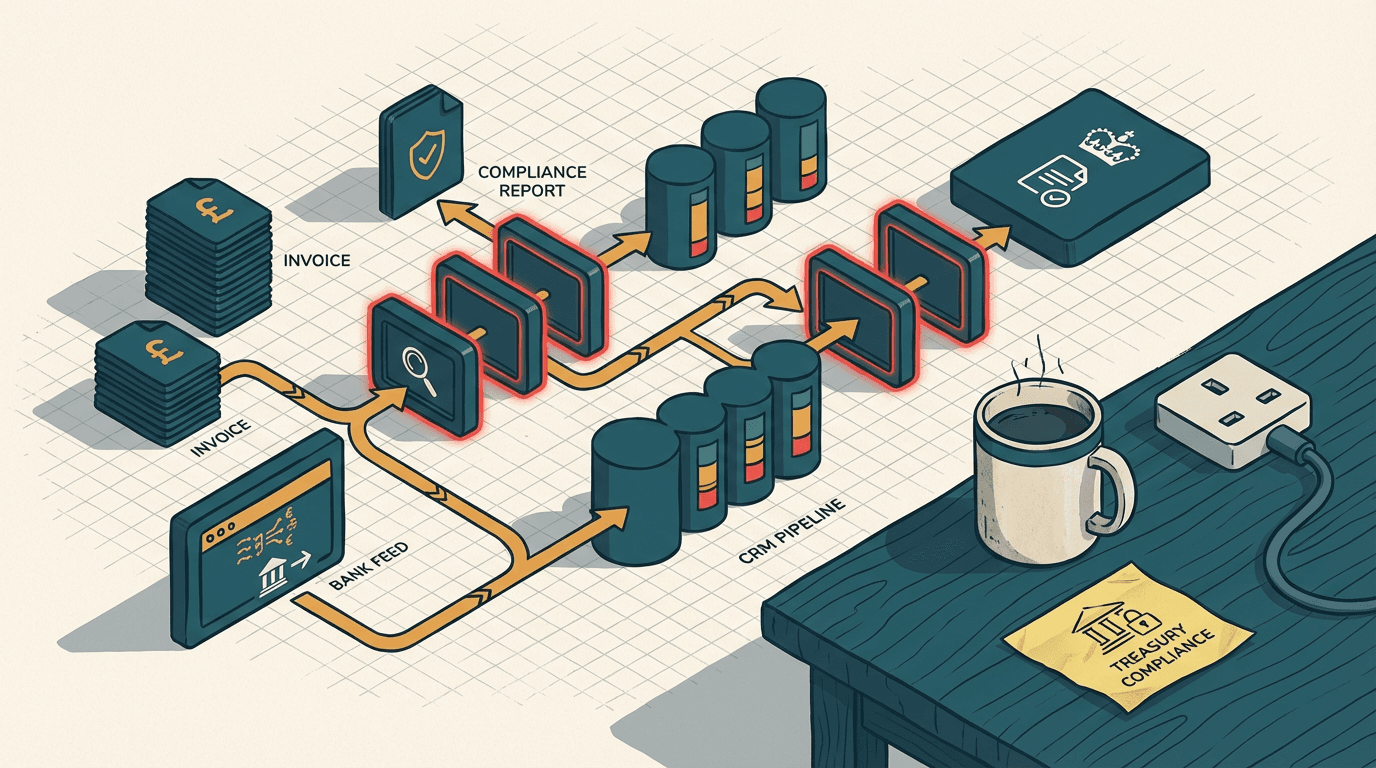
An FCA-ready stress test works by forcing the AI to justify its output against rigid, deterministic logic before any human sees it. You build this using n8n for orchestration, the Claude 3.5 Sonnet API for extraction, and a Supabase database for historical validation. This architecture replaces blind trust with mathematical boundaries.
Trace a real worked example. A messy PDF invoice arrives from a freight forwarder. The n8n webhook triggers a Claude API call. You don't just ask Claude to extract the data. You enforce a strict JSON schema that demands specific data types for every field.
Claude processes the PDF and returns the JSON payload. This is where most SMEs push the data straight to Xero. You don't do that. You never let a probabilistic model write directly to a financial ledger without a bouncer at the door.
Instead, n8n routes the JSON payload to Supabase. A deterministic SQL query checks the extracted unit price against the historical average for that exact supplier over the last 90 days. It also cross-references the VAT number against the Companies House API. If the new price deviates by more than 2%, or the VAT number is unregistered, the system flags it.
Only then does it route to a Slack channel for manual review. But the Slack message doesn't just ask for approval. It attaches the raw PDF, highlights the extracted JSON, and explicitly flags the 2% variance rule that failed. The human isn't checking for general accuracy. They're investigating a specific, calculated anomaly. This turns your ops manager from a rubber stamp into an actual auditor.
This approach costs between £6,000 and £12,000 to build, taking about two to three weeks depending on your existing Xero and Stripe integrations.
The known failure mode here is schema breaking. Sometimes a supplier changes their invoice layout so drastically that Claude fails to populate the required JSON fields. When this happens, the API call fails.
You catch this by building a separate error-handling branch in n8n. If the JSON schema fails validation, the workflow dies immediately and routes the original email to a human accounts assistant with a Parsing Failed tag. The AI is never allowed to guess its way out of a broken schema. It fails loud, and it fails safe.
Where deterministic validation fails
Deterministic validation fails when your core financial inputs are unstructured text. Not standardised digital documents. When I audit SME financial stacks, I always check the data inputs first. If your invoices come in as scanned TIFFs from legacy accounting systems, you need an OCR layer before the AI even touches the file.
Once you do that, the baseline error rate jumps from 1% to around 12%. The AI will start hallucinating numbers because the text layer is garbage. You end up spending more time writing regex scripts to fix OCR typos than you save on manual data entry.
You also hit a wall with email-based negotiations. If your sales reps agree to custom pricing discounts in long Outlook threads, there's no structured purchase order to validate against. The AI can't reliably cross-reference a 2% variance if the agreed price is buried in a six-email chain about a golf trip. The logic gates have nothing to anchor to.
Before committing to this build, audit your data inputs. You need structured purchase orders, clear supplier databases, and digital-native PDFs. If your accounts payable process runs on handwritten delivery notes and verbal agreements, don't build an AI stress test. Fix your basic operations first. You can't automate a mess, and you certainly can't regulate one.
The FCA isn't asking you to stop using artificial intelligence. They're asking you to take responsibility for it. The Treasury Committee is signalling the end of the experimental phase [source](https://www.hoganlovells.com/en/publications/new-developments-for-ai-in-uk-financial-services). You can no longer hide behind your software vendor when a bot makes a catastrophic financial error. The question isn't whether AI can process your supplier invoices faster than a junior bookkeeper. It's whether you have the technical architecture to prove exactly how every single automated decision was made. If your current setup relies on a tired ops manager clicking Approve on a Slack notification, you're already behind. Build the deterministic safety nets now, before the regulator forces you to explain a system you never truly understood.
Get our UK AI insights.
Practical reads on AI for UK businesses — teardowns, how-to guides, regulatory news. Unsubscribe anytime.
Unsubscribe anytime.