How to Avoid the Liability Illusion in Agentic AI Workflows
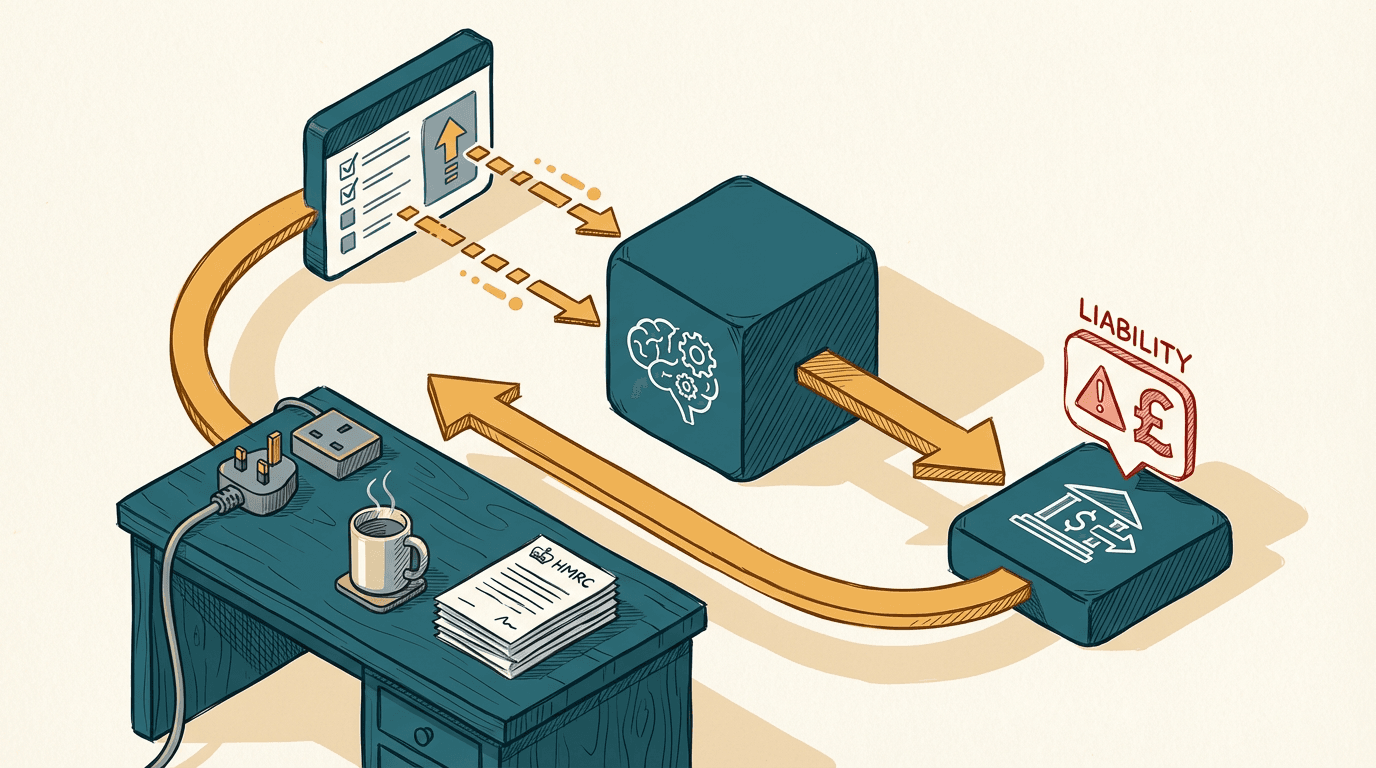
You connect a new AI agent to your shared customer service inbox. You give it a prompt to read incoming emails, check Shopify for order statuses, and draft replies.
It works. The inbox empties itself. You watch the sent folder fill up with polite, accurate responses. You feel like you have just hired a superhuman accounts assistant for £40 a month.
But you haven't. You have just built a liability engine.
Every time that agent opens an email, parses a customer's personal data, and pushes it through an API, it is processing data on your behalf. It does not know what a GDPR breach is. It does not care if it accidentally includes a customer's home address in a cc'd email.
It just executes. And when it inevitably breaks a privacy rule, the fines do not go to the software vendor. They land on your desk.
The liability illusion
The liability illusion is the false belief that deploying an autonomous AI agent transfers the legal and regulatory risk of its actions to the software vendor.
You buy a tool that promises to handle your customer service inbox end-to-end. It reads the emails, checks your Shopify backend, and issues refunds. It feels like you have outsourced the entire department.
But you haven't. You have only outsourced the keystrokes. The legal accountability remains entirely on your balance sheet.
The Information Commissioner's Office (ICO) made this brutally clear in their recent Agentic AI report. They stated that AI agency does not mean the removal of human, and therefore organisational, responsibility for data processing.
If your new autonomous agent hallucinates and sends a customer's billing history to the wrong email address, the ICO does not care that the agent went rogue. They care that you are the data controller. You built the system. You own the breach.
The problem is structural because the technology scales faster than your governance. A human accounts assistant might misread one invoice and cause a minor data breach. An autonomous agent with API access to your entire Microsoft 365 environment can process 10,000 emails an hour.
If its instructions are flawed, it creates a GDPR catastrophe at light speed. The liability illusion tricks founders into thinking a £50 monthly SaaS subscription buys them compliance. It doesn't.
Vendors market these tools as digital employees. But a real employee has legal personhood and accountability. An AI agent is just a very fast, very unpredictable calculator.
Why off-the-shelf agents fail the compliance test
Off-the-shelf agents fail the compliance test because their underlying architecture broadcasts unredacted data to third-party servers by default.
The pattern I keep seeing is founders slapping a manual approval step on top of an off-the-shelf Zapier flow. Or they just buy a generic AI customer service agent and assume the vendor's security badge covers them.
Not vendor compliance. Your compliance.
Here is what actually happens when you rely on a basic Zapier integration to process customer data. You set up a trigger for new emails in Gmail. You pass the email body to a ChatGPT step to summarise the customer's issue. Then you push that summary to Slack.
It sounds harmless. But Zapier is passing the entire raw email straight to OpenAI's servers. That includes email signatures, mobile numbers, and potentially sensitive health or financial data.
Unless you are on a specific enterprise agreement, you have just broadcasted unredacted customer data to a third-party LLM. The agent does not know what data minimisation is. It just reads what you feed it.
The contrarian truth is that putting a human in the loop is a terrible compliance strategy for AI. A human clicking approve on 500 automated summaries a day is not exercising oversight. They are just a rubber stamp.
Fatigue sets in. The human stops reading the text and just trusts the agent's output.
A £25/month ChatGPT subscription cannot replace a £35k compliance officer, and here is the mechanism. LLMs are probabilistic text generators, not deterministic rule engines. They cannot reliably apply GDPR principles because they do not understand them. They just predict the next word.
When an off-the-shelf agent hits a complex data request, it does not pause to consult your privacy policy. It guesses. And yes, that's annoying. But when that guess violates data protection laws, it becomes a legal crisis.
You cannot patch this with a better prompt. Telling an LLM to be GDPR compliant is like telling a spreadsheet to be ethical. The architecture itself fundamentally resists strict data boundaries.
Building a legally bounded agentic workflow

A legally bounded agentic workflow isolates the AI in a restricted sandbox, forcing it to extract specific data without giving it the agency to execute actions.
If you want the efficiency of agentic AI without the liability nightmare, you have to build these workflows. When I build these systems, I do not give the AI the keys to the database. I give it a highly restricted sandbox.
Here is a worked example for processing inbound supplier invoices.
An email arrives in Outlook with a PDF invoice attached. Instead of feeding the whole PDF to a generic agent, an n8n webhook triggers the workflow. n8n extracts the PDF text using a deterministic OCR tool, not an LLM.
It then makes a Claude API call. This is the critical part. You do not ask Claude to process the invoice. You use a strict JSON schema.
The prompt instructs Claude to extract exactly three fields. The invoice number. The total amount. The supplier name.
The prompt explicitly tells Claude to ignore all other text. No bank details. No personal names. No email addresses. Claude returns a clean JSON object. n8n then takes that JSON and pushes it to your Xero draft invoices.
This setup strips out the personal data before it ever hits your permanent records. The AI has no agency to email the supplier. It has no agency to approve the payment. It only extracts three bounded fields.
A system like this takes 2-3 weeks of build time. Expect to spend £6k-£12k depending on the complexity of your existing integrations and how messy your supplier data is.
But you have to plan for failure modes. What happens if Claude hallucinates a different invoice number?
You catch it by adding a deterministic validation step in n8n. Before pushing to Xero, n8n checks if an invoice with that exact number and supplier already exists.
If the amount is over £5,000, n8n routes the JSON to a Slack channel for manual review by the ops manager.
The webhook parses the JSON. If it fails the schema validation, the workflow dies immediately and alerts your team.
This is how you ship real systems that survive an audit. You use AI for the messy unstructured data extraction, and you use hard-coded, deterministic software for the logic and routing. The AI is a cog, not the engine.
By physically separating the extraction from the execution, you break the liability illusion. You retain total control over what data moves where.
When bounded agents hit the wall
Bounded agents hit the wall when they are forced to process unstructured legacy formats or make subjective policy decisions.
This approach works brilliantly for modern, digital-first data. But it is not a universal fix. You need to audit your inputs before you start building.
If your invoices come in as scanned TIFFs from legacy accounting, you need OCR first, and the error rate jumps from 1% to ~12%. LLMs are terrible at reading blurry, handwritten, or low-resolution documents.
If your supply chain relies on handwritten delivery notes, an AI agent will hallucinate data to fill the gaps. You will spend more time fixing the errors than you would have spent doing manual data entry.
Another edge case is nested or highly variable data structures. Zapier's Find steps can't nest, so when your Xero supplier has a custom contact field two levels deep, the automation silently writes null and you only notice at month-end.
If your workflow requires the AI to make a judgement call, do not automate it. Deciding if a customer complaint warrants a full refund or a partial credit is a policy decision. Bounded agents are for extraction and formatting. They are not for policy decisions.
Once you cross the line into autonomous decision-making, your GDPR liability skyrockets. The ICO requires strict safeguards for automated decisions that affect individuals. If you cannot explain exactly why the agent made a specific decision, you cannot deploy it. End of.
What to do now
Locking down your AI exposure requires auditing your active API connections and enforcing strict data boundaries on your existing workflows.
Before you connect another autonomous agent to your business data, start here.
- Audit your active API connections. Open your Google Workspace or Microsoft 365 admin panel. Look at which third-party apps have read access to your shared inboxes. If you see an AI tool you tested three months ago and forgot about, revoke its access immediately.
- Map the data journey. Pick your most active Zapier or Make workflow that uses ChatGPT. Trace exactly what data is passed in the prompt. If you are sending raw email bodies, add a text-parsing step before the AI call to strip out phone numbers and addresses.
- Switch to strict JSON outputs. If you are using Claude or OpenAI APIs, update your prompts to demand JSON schema compliance. Tell the model exactly which fields it is allowed to return. If it returns anything else, configure your webhook to drop the payload.
- Set financial circuit breakers. Open your n8n or Make routing logic. Add a hard rule that any AI-generated action involving a transaction over £500 must route to a Slack channel for human approval. Never let the agent execute the final step alone.
Get our UK AI insights.
Practical reads on AI for UK businesses — teardowns, how-to guides, regulatory news. Unsubscribe anytime.
Unsubscribe anytime.