Eliminating the Assurance Drag Tax with Automated Project Compliance
You walk into the ops office and see your senior project manager staring at a split screen. On the left, a 45-page supplier compliance PDF from a new contractor. On the right, a sprawling Excel risk tracker that hasn't been fully updated since 2024. She is manually checking whether the supplier's insurance policy covers the specific liability thresholds required for your upcoming logistics rollout. It takes her two hours per vendor. Multiply that by 40 active projects, and you are bleeding highly paid talent on administrative box-ticking. You bought Microsoft 365 Copilot hoping it would just read the files, but the reality is your team is still doing the heavy lifting. The gap between what AI promises and what actually happens on your ops floor is massive. Every day, your team is bogged down in the exact same repetitive checks.
The assurance drag tax
The assurance drag tax is the hidden cost of paying senior staff to manually verify project compliance, risk registers, and supplier documentation against internal standards. It is the silent killer of operational margins in any growing business. You hire a £60k operations manager to design better delivery systems, but she spends 30% of her week cross-referencing PDFs against a master spreadsheet.
This tax exists because project assurance is fundamentally a text-matching exercise wrapped in anxiety. The business needs absolute certainty that a subcontractor has the right certifications, or that a project phase meets the internal quality gates before release. Because the stakes are high, you throw human eyes at the problem.
But human eyes get tired. When an ops manager reads their fourteenth risk assessment of the month, they skim. They miss a missing date. They overlook a lapsed accreditation. The irony is that by relying on manual human review for compliance, you are actually increasing your risk exposure while paying a premium for the privilege.
The result is a bottleneck that scales linearly with your revenue. Every new project requires more manual checks. You cannot grow without hiring more administrators, and your senior team becomes trapped in a perpetual cycle of document review.
You end up with a highly qualified team acting as highly paid data entry clerks, entirely consumed by the assurance drag tax. It drains morale just as quickly as it drains profit. Good operators want to build and optimise, not act as human spellcheckers for third-party paperwork.
Why the obvious fix fails
Giving your ops team ChatGPT Plus subscriptions to check compliance documents is the fastest way to automate your mistakes. Most SMEs try this first. They assume chat interfaces can handle rigid compliance work.
They are wrong.
Here is what actually happens. An accounts assistant uploads a 50-page contractor agreement to ChatGPT and types, Check if this meets our project assurance standards. The LLM reads the document, confidently states that everything looks fine, and the assistant ticks the box in your tracker.
But the LLM didn't actually check your internal standards, because it doesn't know them. It just pattern-matched the document against generic business norms. Even if you paste your standards into the prompt, consumer AI tools suffer from attention drift. If the supplier's liability clause is buried on page 42 under a misleading heading, a standard ChatGPT prompt will skip it entirely. The interface is designed to be conversational, not rigorous.
The other common trap is trying to string this together with basic Zapier flows. You set up a Zap to trigger when a new PDF lands in a Gmail folder, send the text to OpenAI, and update a Google Sheet. It breaks within a week.
Zapier's standard text extraction turns complex PDF tables into an unreadable string of characters. When the AI tries to parse a multi-column risk register, it misaligns the rows. It silently approves a critical risk, and you only find out during an external audit.
In my experience, relying on unstructured chat prompts for structured compliance provides the illusion of assurance while quietly introducing catastrophic blind spots. You think you have modernised your operations, but all you have done is replace a slow, accurate human with a fast, overconfident text generator. The liability still rests entirely on your shoulders when a non-compliant vendor slips through the net.
The approach that actually works

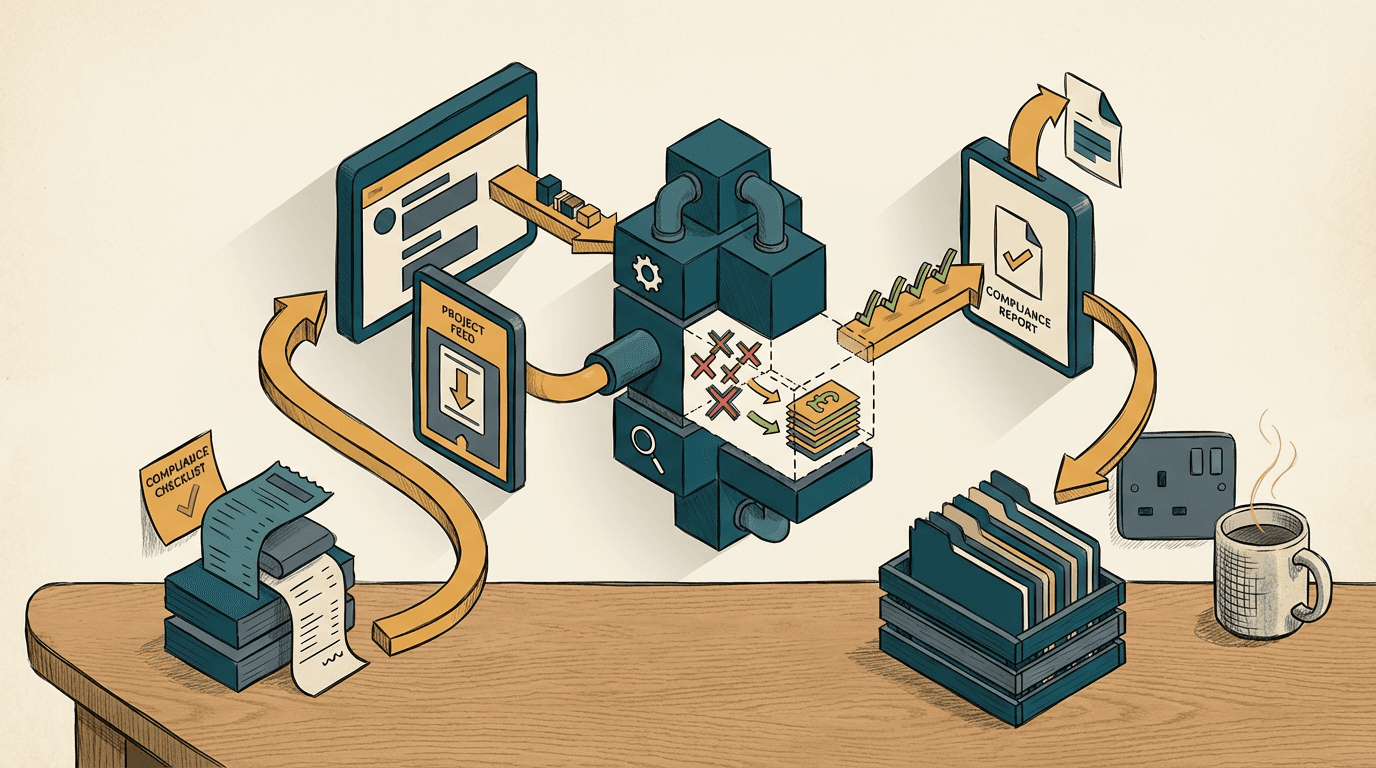
Real project assurance automation requires a rigid data pipeline that ingests documents, extracts data predictably, and evaluates it against a hardcoded framework. You build a system that moves data step-by-step, removing the chat interface entirely.
Here is a concrete build. An email arrives from a supplier with the subject line Q3 Compliance Pack and an attached PDF. An n8n webhook catches the email and strips the attachment. Instead of dumping raw text into an LLM, the system uses a dedicated OCR tool to map the document structure.
Then, it makes an API call to Claude 3.5 Sonnet, forcing the output into a strict JSON schema. The prompt doesn't ask is this good? It asks Claude to extract five specific data points: expiry date, liability limit, named entity, risk score, and missing clauses.
The n8n workflow evaluates that JSON payload against your business rules. If the liability limit is under £1M, the automation flags it. It then PATCHes the supplier's record in Xero, updating a custom field to Review Required, and pings a Slack channel with the exact page number where the discrepancy lives. The human only intervenes when a rule is broken.
If you want to bypass custom builds entirely, dedicated platforms are finally maturing. Tools like FAST (Firewood) are built specifically for this. Recent techUK data shows that using FAST for project assurance reduces review time by 20% and cuts administrative costs by up to 35% per assurance review [source](https://www.techuk.org/resource/ai-adoption-case-study-transforming-project-assurance-with-fast-firewood.html). It works because the AI is constrained to assurance frameworks. It is not an open-ended assistant.
Building the custom n8n pipeline takes about 2-3 weeks and costs between £6k and £12k, depending on how messy your existing supplier data is. The primary failure mode is unexpected document formats, like a supplier sending a password-protected file or a zipped folder of JPEGs.
You catch this by building a failure route in n8n that immediately replies to the sender: Our automated system couldn't read your file, please re-send as an unlocked PDF. This shifts the administrative burden back to the supplier, where it belongs.
You also need to monitor API costs. Processing hundreds of massive PDFs through advanced models can rack up a bill if you don't filter out the noise first. A smart pipeline only sends the relevant pages to the LLM, ignoring the 30 pages of boilerplate terms and conditions that never change.
Where this breaks down
Automated assurance fails completely if your incoming documents are unreadable or your internal compliance rules rely on human intuition.
This approach is not magic. You need to audit your document intake before you write a single line of automation.
If your project documentation comes in as scanned TIFFs from legacy accounting software, or handwritten site safety logs, you need a heavy OCR layer first. Once you introduce handwriting or low-resolution scans, the extraction error rate jumps from 1% to ~12%. At that point, the automation creates more manual exception-handling than it saves. You will spend more time fixing the OCR errors than you would have spent just reading the document.
It also breaks if your internal compliance rules are subjective. If your assurance framework relies on an ops manager getting a good feel for a supplier's risk profile, an API cannot replicate that. AI extracts facts and compares them against rules.
If your rules are not documented as binary thresholds, like a specific date, a specific currency amount, or the presence of a specific named clause, the system will fail. You have to standardise your definitions before you automate the checks. If your current process is built on gut instinct, no software on earth will fix it.
The question isn't whether AI can read a supplier document. It's whether you have the discipline to stop treating compliance as an artisanal craft and start treating it as a data pipeline. Every hour your senior team spends manually verifying insurance limits and project milestones is an hour they aren't fixing real operational bottlenecks. The technology to automate the heavy lifting of project assurance is already here, and it is entirely accessible to an SME budget. But it requires you to step away from consumer chatbots and build rigid, predictable systems. The tools work. The APIs are cheap. Once you strip away the administrative bloat, you finally get to see what your operations team can actually achieve.
Get our UK AI insights.
Practical reads on AI for UK businesses — teardowns, how-to guides, regulatory news. Unsubscribe anytime.
Unsubscribe anytime.