Deploying Computer-Controlling AI Agents Safely in SME Operations
Your ops manager spends twelve hours a week downloading supplier PDFs from Outlook, renaming them, and typing the line items into Xero. You read the March 2026 release notes for Claude Cowork. Anthropic's new feature lets the model directly control a computer, click through desktop apps, and execute multi-step workflows [[source]](https://vertexaisearch.cloud.google.com/grounding-api-redirect/AUZIYQHx_NDpNO08q_Bx_iFvJ0l-5Z2Cg8qbmRAOG195eljdbKLQnSFClgMls3SO1bYgZi7rueu57Gc6PXQf-rX5wBmJMKb7m-9uW1WB8_SstumQ-MO9q6xj4B4bTiJwQdDKvx-4b7ZYckfPEN6TZJ4FZ2Pj42_rPHNps9nrgyuwEIOn_draTl1Ljie-Y05vnbt0SK81q5a7PNsoYwHUL1co3P4-W-ygMirF9m26uxJ7KLp4lFcs). You think you can just hand it a login and get those twelve hours back.
Here's what actually happens: the agent opens the wrong browser tab, misreads a custom tax field, silently writes a null value into your accounting software, and you only find out when VAT is due.
Handing an autonomous model the keys to your desktop isn't a simple software upgrade. It's a massive operational risk. GPT-5.4 and agentic AI are brilliant at reasoning, but they do not understand the financial blast radius of a wrong click [[source]](https://vertexaisearch.cloud.google.com/grounding-api-redirect/AUZIYQFlZGfQ8erVIQFF72WGdQRYDQX4ZgDnCrcg-Pwe0Lmo96nYQzHUwpzsfXlE98masDcxyniRAZSKzs8UyuUTbqanskHC0G3Dg4heXjOt9IphZZQHuSC7XR4SQcIvXnRQdai3PaHreGUfjdwdMGw9ERJKZ3UplYdxx6zZovgTXO-E-UQEQg3ACiMU7cO4gZZSBtjL). If you want to deploy computer-controlling agents in your business, you need a strict protocol.
The desktop automation gap
The desktop automation gap is the dangerous space between an AI agent knowing which button to click and actually understanding the financial consequences of clicking it.
When a human bookkeeper processes a complex invoice, they are constantly running silent, contextual checks. They notice if a supplier has suddenly changed their bank details. They spot when a line item for software subscriptions includes a sneaky setup fee that needs a different tax code. They pause when Xero throws a subtle warning banner.
An AI agent operating your desktop does not have that innate hesitation. Models like Claude Cowork are designed to execute the goal you give them. If you tell an agent to clear the inbox and reconcile the attachments, it will relentlessly click, copy, and paste until the task is complete.
It treats a routine utility bill and a highly sensitive payroll adjustment with the exact same level of mechanical confidence.
Models like Claude Cowork and GPT-5.4 are incredible at reasoning through a problem in a text box. But the desktop is not a text box. It is a chaotic, stateful environment. A pop-up notification from Slack, a forced Windows update, or a slightly rearranged Microsoft 365 dashboard can completely derail an agent's visual anchor points.
When an agent loses its place, it doesn't always stop and ask for help. Often, it just guesses. This happens because software companies built visual desktop environments for human eyes, not machine logic. Humans use spatial memory and context to navigate. We know the 'Submit' button is usually at the bottom right, even if a banner ad pushes it down.
An AI agent relies on DOM elements, accessibility trees, or pure pixel coordinates. If Xero updates its CSS overnight, your human ops manager barely notices. Your agentic AI clicks empty space and crashes.
For a UK SME, this is a structural nightmare. You are legally responsible for the data you submit to Companies House and HMRC. You cannot blame a hallucinating model for a botched tax return.
Founders treat agentic AI like a smart human intern. It is actually an incredibly fast, highly capable bulldozer operating in a china shop. You have to build the fences before you turn the engine on.
Why the obvious fix fails
The obvious fix fails because basic Zapier workflows and generic AI subscriptions cannot handle the unstructured, nested data of real SME admin.
Most founders think the solution is just buying an off-the-shelf AI tool or stringing together Zapier webhooks. Not true. The pattern I keep seeing is SMEs trying to bypass the desktop entirely by wiring their inbox directly to their accounting software. They buy a £25/month ChatGPT subscription, hook it up to Zapier, and assume they have replaced a £35k salary.
It fails almost immediately. Zapier's Find steps can't nest, so when your Xero supplier has a custom contact field two levels deep, the automation silently writes null and you only notice at month-end. And yes, that's annoying.
This is the exact point where the system breaks. A standard SaaS integration expects perfectly structured data. But SME admin is fundamentally unstructured. Suppliers send invoices in the body of an email. Clients reply to automated Stripe receipts with complex billing questions.
When a rigid flow encounters an edge case, it either crashes loudly or fails silently. End of.
To fix this, founders swing to the other extreme. They read that GPT-5.4 is now available as an agent model that can handle complex workflows. They install a desktop agent, give it broad permissions, and tell it to just "figure it out."
This is a catastrophic security risk. When you give an agent unrestricted access to your local machine, you are giving it access to your entire authenticated session footprint. It can read your Slack DMs. It can access your saved Chrome passwords. It can theoretically execute malicious code embedded in a phishing email because it has the authority to click 'Run'.
A £25/month subscription cannot replace a £35k salary because the salary pays for judgment, not just typing. The human knows that an invoice from "Amazon Web Services" goes to IT infrastructure, but an invoice from "Amazon" for coffee pods goes to office supplies.
The generic AI setup lacks this context. You end up spending more time auditing the AI's mistakes than you would have spent doing the data entry yourself. The mechanism is flawed from the start.
The sandbox-and-verify protocol

The sandbox-and-verify protocol is a deployment method where the AI agent operates in an isolated virtual machine and must pass strictly formatted JSON data to an API for validation before any system updates occur.
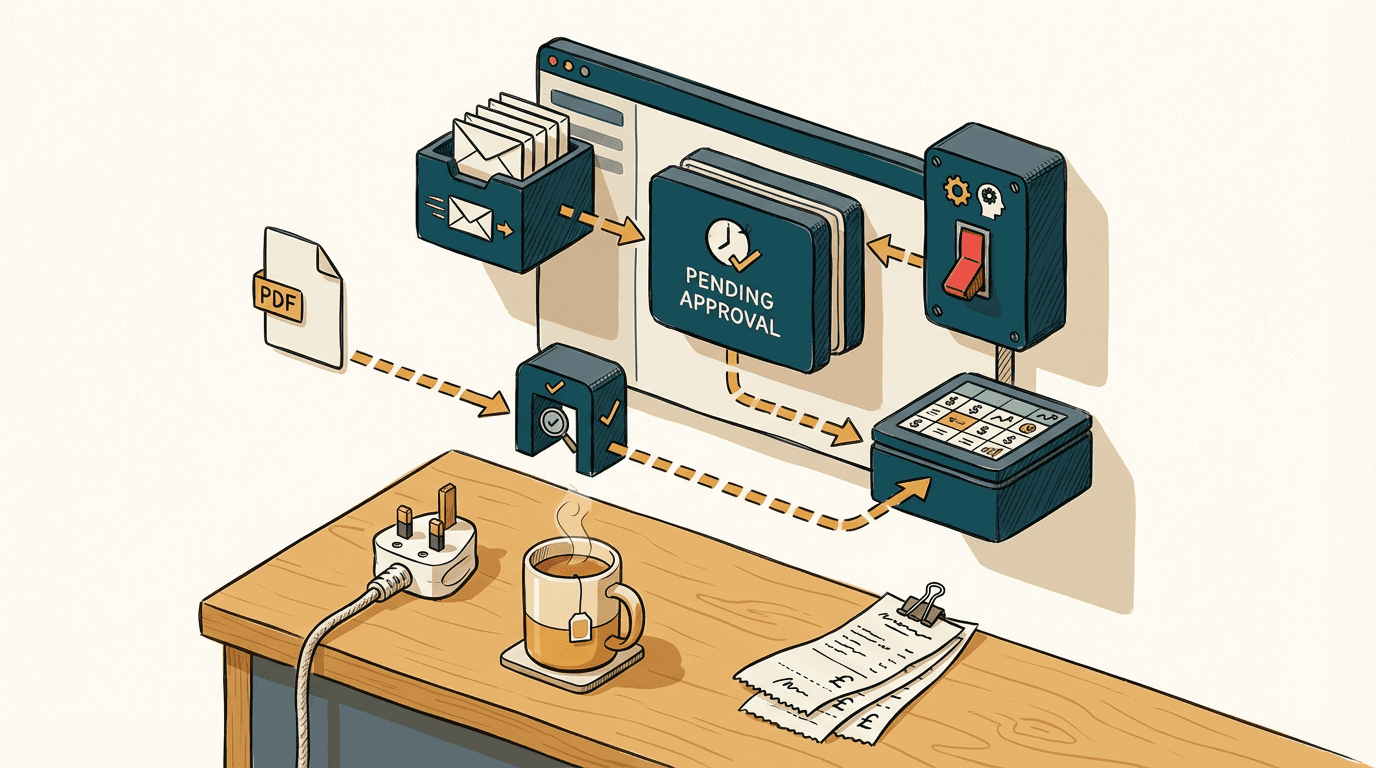
You need to isolate the agent's environment and constrain its output. You do not let a model click "Approve" in your live accounting system. Here is what actually happens in a secure deployment. Let's look at processing a 40-line PDF invoice from a supplier like DPD.
First, you set up a dedicated virtual machine. This is your sandbox. You install Claude Cowork here, not on your ops manager's primary laptop. The VM has no access to your company's internal network, no saved passwords, and no Slack access. It only has access to a specific, restricted Outlook inbox where supplier invoices land.
The agent reads the email and opens the DPD PDF. It uses its vision capabilities to extract the line items, the VAT numbers, and the totals. But instead of letting Claude Cowork open Xero and type the numbers in, you force it to output the data in a strict format.
The n8n webhook triggers a Claude API call with a strict JSON schema. The model must format the extracted data to match this exact schema. If the JSON is malformed, n8n rejects it and forces the model to try again.
This is the crucial security layer. You are moving from an unpredictable visual environment into a highly predictable data structure. Once n8n validates the JSON, the workflow takes over. The n8n automation then PATCHes the Xero invoice line items as a "Draft".
The final step is the human-in-the-loop. Your ops manager logs into Xero, reviews the draft invoices, and clicks approve. The AI does the heavy lifting of extraction and data structuring. The human retains the final financial authority.
To build this properly, you need 2-3 weeks of build time and roughly £6k-£12k depending on your existing integrations.
The known failure modes are highly specific. Claude Cowork will occasionally get stuck if a supplier sends a password-protected PDF. Or the model might hallucinate a tax rate if the invoice is blurry.
Because you have the n8n validation layer, the system catches the error before it hits Xero. The webhook flags the anomaly, pauses the workflow, and sends a Slack alert to your team. You isolate the risk. You structure the data. You verify the output. That is how you ship agentic AI safely.
Where this breaks down
This constrained approach breaks down completely when you apply it to legacy on-premise software or illegible scanned documents.
Before you commit to building a sandboxed agent, you need to audit your existing tech stack. If your apps are cloud-based with modern APIs, you are in a strong position. If your business relies on a 15-year-old ERP system that only runs on a local server and requires physical 2FA tokens, an AI agent will struggle.
The desktop automation gap widens significantly when the visual interface looks outdated. Modern models learn from modern web UI. They understand how a Shopify dashboard or a HubSpot CRM works. They get confused by terminal-based interfaces or heavily customised legacy desktop applications where the tab order makes no logical sense.
Data quality is the other major blocker. If your invoices come in as scanned TIFFs from legacy accounting, you need OCR first, and the error rate jumps from 1% to ~12%. Agents cannot magically reconstruct missing pixels. If the human eye cannot read the supplier's bank details, the model will either fail or invent a number.
Never deploy an agent to handle a process that is already broken. If your manual reconciliation process is a mess of undocumented exceptions and gut-feeling decisions, the AI will just execute that chaos at scale. Fix the process first. You cannot automate around bad operations.
The question isn't whether GPT-5.4 replaces your ops manager. It's whether you know which £32k of her week is actually spent matching DPD invoices against Stripe payouts. Because right now, that is the only part a constrained agent can safely touch. Buying a subscription and hoping for the best is a fast track to a corrupted ledger. You have to build the sandbox, enforce the schema, and keep the final approval firmly in human hands. Get the security protocol right, and you buy back thousands of hours of high-value time. Get it wrong, and you will spend the next six months untangling a phantom financial mess. The tech is finally ready to do the heavy lifting. The real test is your operations.
Get our UK AI insights.
Practical reads on AI for UK businesses — teardowns, how-to guides, regulatory news. Unsubscribe anytime.
Unsubscribe anytime.