How to Avoid the AI Deliverability Cliff in B2B Outreach
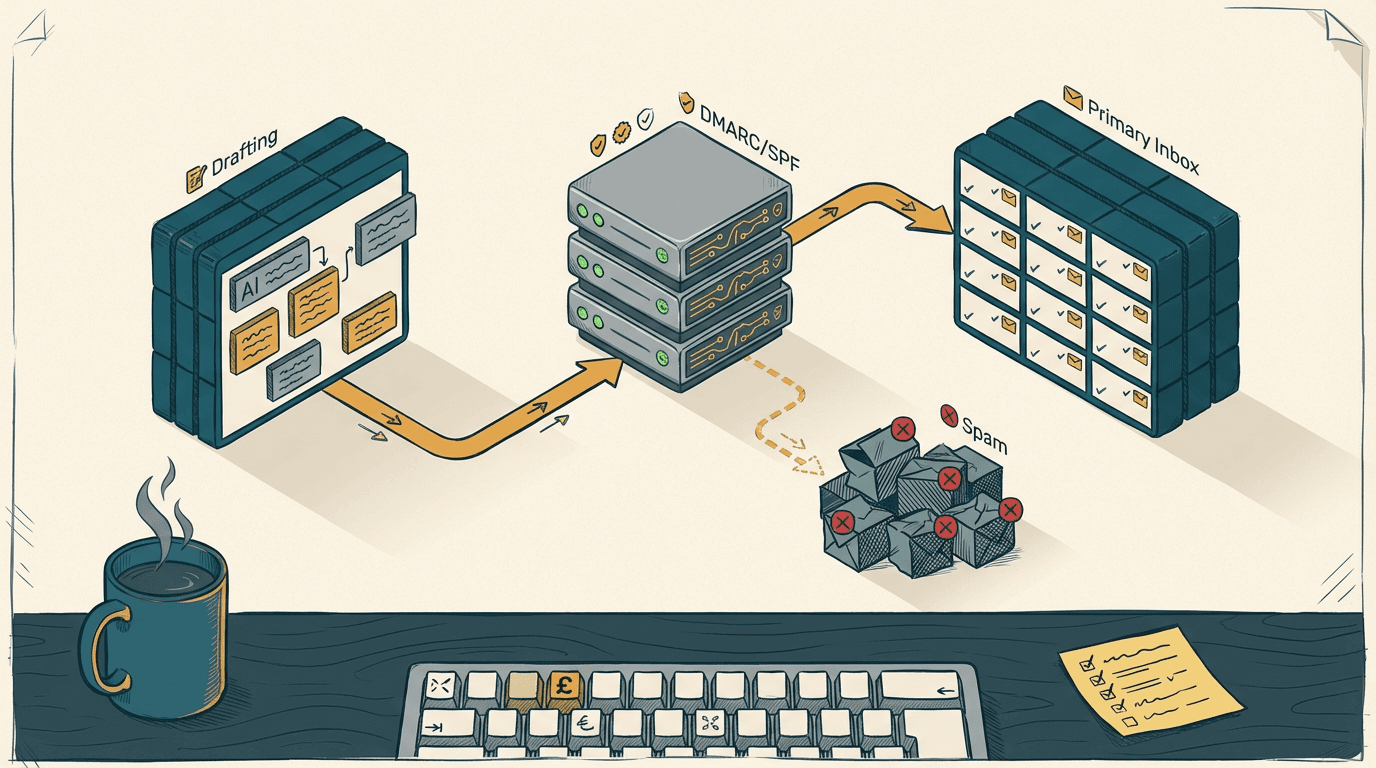
You write a prompt. You connect it to your CRM. You tell it to generate a unique opening line for 2,000 prospects. You hit send. The emails look brilliant. They reference recent news. They sound human. You sit back and wait for the calendar to fill up.
Nothing happens. Not a single reply. You check the open rates, and they are hovering around 2%. Your AI sales outreach is not generating B2B lead gen. It is generating spam. Founders love the idea of infinite scale. You buy a tool, plug in an OpenAI API key, and suddenly you have a tireless sales rep.
But the infrastructure underneath email cannot handle infinite scale. The pipes are full. The gatekeepers have changed the locks.
The AI deliverability cliff
The AI deliverability cliff is the exact moment your automated outbound volume triggers Google and Yahoo's new authentication filters, banishing your entire domain to the spam folder overnight. It happens fast. You scale your sending volume from 50 emails a day to 500. For three days, it works. On day four, your open rates drop to zero.
Google and Yahoo changed the rules. They introduced strict new protections for a safer inbox, requiring bulk senders to authenticate their emails and keep user-reported spam rates below 0.3% [source](https://blog.google/products/gmail/gmail-security-authentication-spam-protection/). Most SMEs miss the technical reality of this update. They think a good subject line saves them. It doesn't.
Email deliverability is now a hard engineering problem. It requires properly configured SPF, DKIM, and DMARC records. If you skip these, Google's servers reject your connection before your clever AI copy even reaches the spam filter. The AI deliverability cliff catches founders because the software makes sending easy.
You can generate 10,000 emails in ten minutes. But your domain reputation is a physical constraint. It builds slowly and shatters instantly. The new baseline is strict. You must publish a DMARC policy. You must align your sending domains. You must support one-click unsubscribe headers.
If your AI sales outreach tool sends a batch of 5,000 emails without these headers, the receiving servers simply drop them. No bounce message. No warning. Just silence. Once you fall off the cliff, recovery is brutal. Your legitimate invoices start going to spam. You spend weeks begging Microsoft 365 support to unblock your IP address.
Why mailbox warmup tools fail the new filters
Mailbox warmup tools fail the new filters because Google's machine learning now easily detects the artificial ping-pong of automated replies used to inflate sender reputation. The standard advice for B2B lead gen is everywhere. Buy ten secondary domains. Hook them up to Instantly or Lemlist. Turn on the automated warmup feature for two weeks. Then blast your AI sales outreach.
This is a terrible idea. The mechanism used to work. A network of fake inboxes would receive your emails, pull them out of the spam folder, and reply with generic AI text. This tricked the algorithms into thinking you were a high-value sender. Not anymore.
Google Workspace and Microsoft 365 analyse the metadata of these interactions. They see thousands of accounts with zero real-world activity, all emailing each other in predictable patterns. They identify the warmup network. Then they penalise every domain touching it. I see this pattern constantly.
A founder spends £500 on new domains and warmup subscriptions. They wait three weeks. They launch the campaign. The spam rate immediately spikes to 0.8% because real humans hit the spam button. The warmup volume can't dilute the real-user spam complaints. Once real prospects mark you as spam, the algorithm overrides any artificial positive signals.
You can't trick a trillion-dollar company's spam filter with a £30 SaaS subscription. The AI deliverability cliff waits for everyone who tries to cheat the reputation system. Most outbound agencies will tell you to just cycle domains faster. Burn them and buy more. It's a toxic cycle.
You end up managing a massive spreadsheet of burned URLs, constantly updating DNS records, and fighting a losing battle against the spam filters. The entire approach treats the symptom, not the disease. The disease is sending low-signal noise at high volume. You have to build actual trust. You have to send emails that people don't flag as junk.
The authenticated signal-based outbound stack

The authenticated signal-based outbound stack relies on strict DNS protocols and API-driven personalisation to send fewer, highly targeted emails that bypass modern spam filters. You need to stop sending 1,000 generic emails a day. You need to send 50 hyper-relevant emails a day, fully authenticated. Here is what the actual build looks like.
First, the infrastructure. You buy three secondary domains. You set up Google Workspace for each. You configure SPF and DKIM. You publish a DMARC record starting with p=none, moving to p=quarantine after a month of monitoring. Next, you build the signal catcher. You don't buy a static list of 10,000 emails. You use n8n to monitor a live data.
Say you sell logistics software. You set up an n8n webhook to catch new public filings from Companies House. When a target company files an annual return showing increased inventory costs, the webhook fires. This triggers a Claude API call. You don't just ask Claude to write a sales email. That results in bloated nonsense.
You pass the Companies House PDF text to Claude with a strict JSON schema. You ask it to extract three specific values: the total inventory value, the stated reason for the increase, and the name of the operations director. Then, a second Claude API call drafts the email. You constrain the prompt heavily.
Write a 50-word email. Mention the inventory value in the first sentence. Ask one question. Use no adjectives. Finally, n8n pushes this drafted text and the prospect's details into HubSpot or Smartlead via API. You review the draft. You hit send. This setup costs about £4k to £8k to build, taking two to three weeks depending on data complexity.
Running it costs pennies per API call. The failure mode here is poor data extraction. If the Companies House filing is a scanned image rather than text, Claude will hallucinate numbers. You catch this by adding a validation step in n8n. If the extracted JSON doesn't match the expected data types, the workflow skips the email and flags it for Slack review.
This is how you scale. Not by blasting noise, but by automating the deep research that a senior rep would do.
Where signal-based outbound falls apart
Signal-based outbound falls apart when your target market lacks public digital footprints for an AI agent to parse. You can't extract signals from a void. If you sell to local plumbing firms, independent cafes, or high-street retail, this system breaks. They don't file detailed strategic reports on Companies House. They don't post thought leadership on LinkedIn.
When you point an AI at a sparse data, it panics. It tries to be helpful. It hallucinates a connection that doesn't exist. You end up sending an email to a cafe owner congratulating them on their recent strategic expansion into the espresso vertical. It's embarrassing. It damages your brand faster than a generic template ever could.
If your invoices come in as scanned TIFFs from legacy accounting, you need OCR first, and the error rate jumps from 1% to ~12%. The same applies to outbound data. If you have to scrape badly formatted local directories or rely on outdated Google Maps listings, the data quality is too poor to feed into an LLM.
You'll spend more time fixing the broken JSON outputs than you would have spent just writing the emails yourself. Before you build a complex n8n workflow, manually check ten prospects. Can you find a specific, compelling reason to contact them using only public data? If it takes you twenty minutes of digging to find one weak hook, the AI will fail.
In those cases, you don't need AI sales outreach. You need to pick up the phone.
Three questions to sit with
The era of cheap, infinite email reach is over. The filters are too smart. The gatekeepers have closed the loopholes. You have to adapt your infrastructure and your strategy to match the new reality of the inbox. Ask yourself these questions before you launch your next campaign.
- Do your current sending domains fully align with strict DMARC policies, or do you rely on default settings that leave you vulnerable to instant spam filtering?
- If you turned off your automated mailbox warmup tool today, would your actual prospect engagement stay high enough to keep your domain reputation positive?
- Can you articulate the exact public data signal that triggers your outreach, or do you just use AI to rewrite the same generic pitch a thousand times?
Get our UK AI insights.
Practical reads on AI for UK businesses — teardowns, how-to guides, regulatory news. Unsubscribe anytime.
Unsubscribe anytime.