Stop the Passive Renewal Bleed: Using AI to Automate Procurement
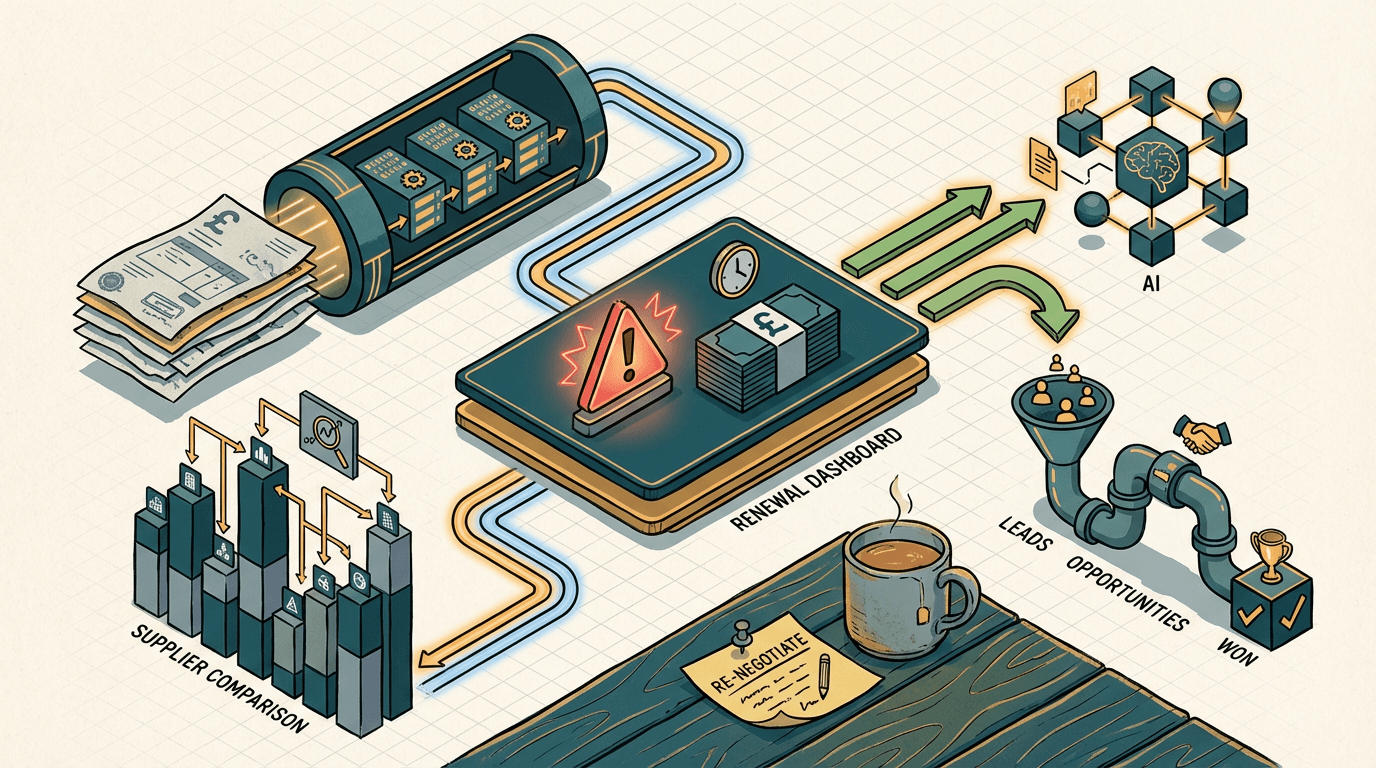
Your inbox pings on the 28th of the month. It's your packaging supplier. Raw material costs are up, transport is up, so your double-walled boxes now cost 8% more. You sigh, forward the email to your accounts assistant, and tell them to update Xero. You do not negotiate. You do not check Alibaba for alternatives. You simply do not have the time.
This happens across your supply chain every single quarter. You eat the cost, or you pass it to your customers and hope they don't churn. It feels inevitable.
But a growing number of UK SMEs are refusing to play this game. They are using automation to evaluate suppliers and negotiate terms without adding headcount. It works, but only if you build the right system from the start.
The passive renewal bleed

The passive renewal bleed is the compounding margin loss a business suffers when it accepts supplier price hikes by default because checking the market is too manual. It happens quietly. A 5% bump in logistics fees here. A 9% increase in software licenses there.
You accept these hikes because the alternative is exhausting. Finding a new supplier means pulling historical invoices, extracting line items, and mapping out your exact annual volume. Then you have to find three competitors, request quotes, and compare them.
Nobody in a 30-person company has time for that. Your ops manager is busy putting out fires on the warehouse floor. Your accounts assistant is chasing unpaid invoices. So the price increase gets approved. Your margins shrink. The cycle repeats.
The core issue is data asymmetry. Every supplier sends PDFs formatted differently. Your Xero data is a mess of vague descriptions like "Monthly Supply" or "Assorted Materials". You cannot compare apples to apples when one supplier bills by the kilogram and another by the pallet. This asymmetry keeps you locked in.
But the tide is turning. Recent data shows 59% of UK SMEs are now using AI tools to evaluate suppliers and negotiate better terms, choosing innovation over inflation. They are fighting back.
They are not doing this by hiring junior analysts to manually scrape competitor websites. They are doing it by turning unstructured supplier data into a structured database. Once you have the data, the negotiation takes care of itself.
Why the obvious fix fails
The obvious fix fails because people try to use ChatGPT as a procurement consultant instead of a data parser. The standard playbook is predictable. A founder buys a £25 monthly ChatGPT Plus subscription, uploads a supplier quote, and asks the model to write a tough negotiation email.
This is a waste of time. A £25 subscription cannot replace a £35k salary, and here's the mechanism. Negotiation is not about aggressive adjectives. It is about leverage. If you do not have alternative market prices, you have no leverage.
So SMEs try to automate the market research. They set up a Zapier flow. It watches a Gmail inbox for supplier quotes, rips the PDF attachment, and sends the text to OpenAI.
Here is what actually happens. Zapier's default PDF extraction strips out the tabular structure. The columns collapse. The LLM receives a wall of mashed text where product codes, quantities, and prices bleed into each other.
The model then hallucinates the unit economics. I see this constantly. It sees a line for "Pack of 10" and a price of "£40", and silently logs the unit price as £40. You only notice the error when you try to use that data to negotiate and look foolish.
Most SMEs who try this hit the same wall. They assume AI understands business context by default. It does not. It is a text prediction engine. If you feed it garbage text from a flattened PDF, it predicts garbage insights.
You cannot negotiate with bad data. Using AI to generate emails is the last 1% of the process. The real work is structuring the data. If your automation relies on a chat window rather than a strict data pipeline, it will break.
The approach that actually works

The approach that actually works uses an orchestration tool to force LLMs to output strict, structured data into a central database. You stop treating AI as a chatbot and start treating it as a translation layer.
Here is the exact build. You set up a dedicated procurement inbox. When a supplier emails a new PDF price list, an n8n webhook catches the payload.
The webhook sends the PDF directly to the Claude 3.5 Sonnet API. You do not ask Claude for a summary. You provide a strict JSON schema. You tell the API to extract the SKU, the unit of measure, the pack size, and the raw unit price.
Claude parses the tabular data perfectly. The n8n workflow then pushes that clean JSON directly into an Airtable base. You now have a structured record of exactly what you are paying, down to the gram or the millimetre.
Next, you automate the market comparison. A separate n8n workflow takes those SKUs and queries an external data. This might be an Alibaba API, a supplier portal, or a scraped competitor site. It pulls the current market rate for the exact same unit of measure.
A formula in Airtable calculates the delta. If your current supplier is charging 15% above the market rate, the system flags it. It drafts a factual email highlighting the discrepancy, ready for your ops manager to review and send.
This system takes about two to three weeks to build. Expect to spend £6k to £12k depending on how messy your existing Xero data is and how many supplier formats you need to map.
The main failure mode is the LLM breaking the JSON structure, causing the database insert to fail. You catch this by enforcing strict structured outputs in the API call and adding an error-handling route in n8n that alerts you on Slack if the parse fails.
Once you run this, the passive renewal bleed stops. You walk into every supplier conversation knowing exactly what their competitors charge. You do not need to bluff. You just present the data.
Where this breaks down
This system breaks down when your historical procurement data is trapped in legacy formats that require heavy preprocessing. AI is good, but it cannot read a doctor's handwriting on a tea-stained delivery note.
If your invoices come in as scanned TIFFs from a legacy accounting system, you need an OCR step first. Once you rely on basic OCR before the LLM, the error rate jumps from 1% to around 12%. Bad data enters the system, and your market comparisons become useless.
It also fails when you buy highly bespoke services. You can easily compare the price of corrugated cardboard boxes, standard steel bearings, or commercial cleaning supplies. You cannot use an Alibaba API to compare the price of custom software development or specialist legal advice.
Before you commit to building this, audit your top ten suppliers. I always tell founders to look at how they format their invoices. If the data is digital and the products are commoditised, you can automate the comparison. If the products are custom and the invoices are handwritten, fix your manual processes first. Do not digitise a broken process.
Three mistakes to avoid
- DON'T automate the final email send. Never let an AI send a negotiation email to a supplier without human review. The system should draft the email and save it in your Gmail drafts folder. If the LLM misinterprets a unit price and aggressively demands a 90% discount, you will destroy a valuable supplier relationship. Always keep a human on the button.
- DON'T rely on generic ChatGPT for data extraction. Using the standard web interface to parse complex PDFs is a trap. The web app applies hidden system prompts that prioritise conversational answers over strict data extraction. You need to use the API with a defined JSON schema. If you skip this, your data will be inconsistent, and your database will break.
- DON'T ignore unit conversions. Suppliers deliberately use different units of measure to make price comparisons difficult. One sells by the kilogram, another by the metric tonne. Do not assume the LLM will automatically convert these accurately. You must explicitly instruct the API to standardise all quantities to a single base unit before pushing the data to Airtable. If you miss this step, your automated market comparison will be completely wrong.
Get our UK AI insights.
Practical reads on AI for UK businesses — teardowns, how-to guides, regulatory news. Unsubscribe anytime.
Unsubscribe anytime.