The EU AI Act: Why Small Businesses Face Hidden Compliance Risks
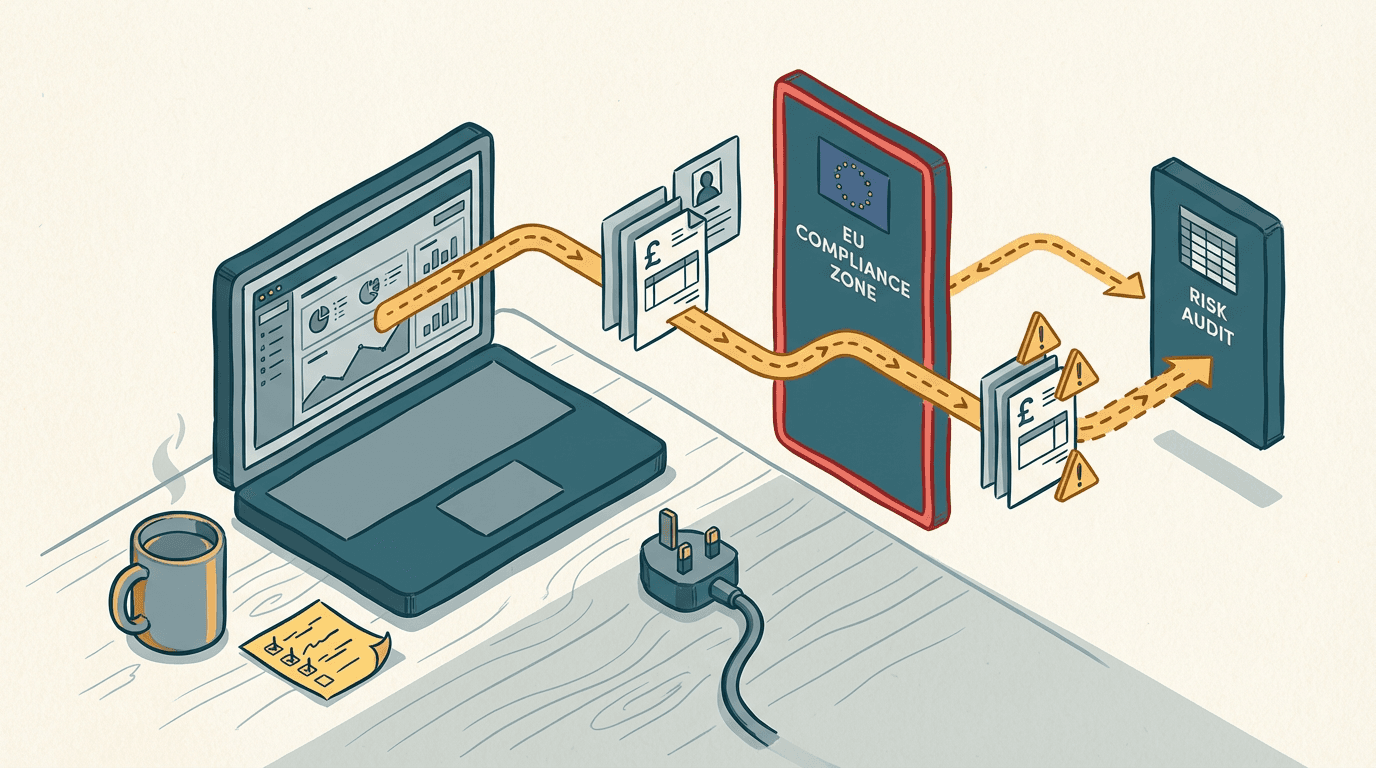
You open Zapier. You watch a webhook catch an email from a German supplier, pass the PDF to an OpenAI module, and drop the parsed line items into Xero.
It runs quietly in the background. It saves your accounts assistant three hours a week. It also means you are now legally a deployer of an AI system under foreign law, and that silent automation is exporting AI outputs across a regulated border.
The EU AI Act officially entered into force on 1 August 2024 [source](https://ec.europa.eu/commission/presscorner/detail/en/ip_24_4089). The grace period for the heaviest rules ends in August 2026. Most UK founders treat this as a Big Tech problem. They assume it only applies to companies training massive foundation models in shiny data centres.
It isn't. If your software, your support desk, or your automated sales outreach touches a European post code, you are on the hook. You don't need to be an AI company to fall under the scope of the Act. You just need to be a business that uses modern tools to serve European clients.
The shadow deployment trap

The shadow deployment trap is the accumulation of unmapped, cross-border AI workflows that your team has built using off-the-shelf tools without legal oversight. It happens because AI isn't something you buy from a vendor in a neat, shrink-wrapped box. It is a feature embedded in every SaaS product your ops manager already pays for.
You think you're just using Notion to summarise meeting notes. You think you're just using HubSpot to draft follow-up emails to French leads. But the EU AI Act doesn't care if you wrote the underlying neural network.
If you use an AI tool to generate output that is sent to an EU resident, you are legally classified as a "deployer". That carries immediate weight. It mirrors the exact extraterritorial reach of GDPR. You don't need a physical office in Paris to be fined by a French regulator. You just need to process their citizens' data through an unlabelled algorithm.
The trap snaps shut because these micro-automations are entirely invisible to leadership. A junior analyst connects an API key to a spreadsheet to clean up some messy supplier data. It works. They share it with the wider team. Suddenly, your business relies on a cross-border process that no one documented, no one vetted for risk, and no one can easily switch off.
You end up carrying the compliance liability for systems you don't even know exist. And because they live in the browser rather than the codebase, traditional IT audits miss them completely. The shadow deployment trap catches you precisely because it looks like everyday productivity.
Why the obvious fix fails
The default reaction to incoming regulation is to buy a compliance scanner or draft a static AI policy. Most SMEs try to solve this by purchasing legal tech that audits their codebase, or by circulating a PDF that tells staff to be careful with ChatGPT. Neither approach survives contact with reality.
Here is what actually happens when you rely on code scanners. You spend £4,000 on an automated auditing tool. It connects to your GitHub repository. It reads your proprietary Python scripts. It gives you a clean bill of health.
But you are an SME. Your actual business logic doesn't live in GitHub. It lives in Make, Zapier, and Airtable.
The scanner skips your automation platform entirely because it only reads Git commits. Meanwhile, a sales rep sets up a Zapier flow to draft contract summaries for European prospects using an OpenAI module. The data flows out of your CRM, hits servers in California, generates a prediction, and lands in a Berlin inbox.
The pattern I keep seeing is that your expensive compliance tool is completely blind to it. It checks the front door while the back door is wide open. And yes, that's annoying.
The static policy document fails for a different reason. You tell your team to log every AI tool they use. They ignore you. They don't view a smart reply feature in Gmail or a summarisation button in Slack as "using AI". They just see a feature that saves them time.
Once you treat AI compliance as an IT security checklist, you lose. The technology moves too fast, and the barrier to entry is too low. You can't govern APIs with a PDF. People will always choose the path of least resistance, and right now, that path is an unmonitored API call.
The approach that actually works

The only reliable way to manage cross-border AI risk is to route all automated decisions through a central, auditable gateway. You stop letting individual SaaS apps make direct API calls to LLMs. You force the traffic through a single choke point that logs the request, checks the risk tier, and applies the necessary disclosures.
Here is how you build it. Take a standard customer support triage system.
An email arrives from a Spanish customer with the subject line "Factura incorrecta". Instead of letting a native Zendesk AI feature handle it blindly, you route the event through an orchestration tool. An n8n webhook catches the email. It triggers a Claude API call with a strict JSON schema to classify the intent and extract the invoice number.
Because this workflow interacts with an EU citizen, it falls under the "Limited Risk" category of the EU AI Act. That means transparency is mandatory. The user must know they are talking to a machine.
The n8n workflow parses the JSON. It updates the HubSpot ticket. Crucially, before it sends the automated reply, it appends a hardcoded disclosure: "This is an automated summary generated by AI." It then logs the interaction, the model version, and the user's region in a Supabase database.
You now have an operational AI registry. When an auditor asks what AI systems you deploy in Europe, you don't guess. You query the database. You can prove exactly what data went in, what model processed it, and what label was attached to the output.
This takes 1-2 weeks of build time. Expect to spend £3k-£5k to map your existing flows and route them through the n8n gateway. It's cheap, it's fast, and it actually works.
The main failure mode is staff bypassing the gateway and spinning up their own direct API keys. You catch this by setting up billing alerts on your Anthropic and OpenAI corporate accounts. If the monthly spend spikes but the n8n token logs stay flat, someone is running shadow workflows. You track down the rogue API key, revoke it, and force the process back into the light.
Where this breaks down
This lightweight gateway model falls apart entirely if your product touches any of the EU's designated high-risk categories. You need to know exactly where that line is drawn before you start building.
If you use AI to draft emails, summarise PDFs, or route support tickets, the gateway approach is perfect. You are dealing with minimal or limited risk. You apply transparency labels, log the usage, and get on with your day.
But if your SME builds software for HR screening, credit scoring, or biometric categorisation, you are operating in Annex III territory. The rules change completely.
If your platform uses an LLM to parse CVs and rank candidates for a client in Dublin, a simple n8n log won't save you. You are now a provider of a high-risk system. You need a formal conformity assessment, continuous post-market monitoring, and CE marking. The error rate for a missed compliance step here is fatal.
The compliance cost jumps from a £5k operational registry to £40k+ for external auditing and legal restructuring. Don't try to hack high-risk compliance with no-code tools. If you're in those sectors, my advice is blunt: you need specialist legal counsel, not a better webhook. The gateway gives you visibility, but it doesn't give you legal cover for high-risk automated decisions.
Three questions to sit with
The EU AI Act is not a distant problem for tech giants. It's a live operational constraint for any UK business that exports digital services, software, or automated support across the Channel. The grace period is ticking down, and the fines for getting this wrong are severe enough to end a business. You can't afford to ignore the workflows your team is already running.
Take a hard look at your current stack. Ask yourself these three questions:
- When your sales team uses AI to draft proposals for European clients, who exactly is logging that system's risk tier?
- If an EU regulator asked for a list of every LLM API key active in your business today, how many days would it take you to find them all?
- Does your current customer terms of service explicitly state which support channels are routed through automated decision-making?
Get our UK AI insights.
Practical reads on AI for UK businesses — teardowns, how-to guides, regulatory news. Unsubscribe anytime.
Unsubscribe anytime.