Beyond the AI Bubble: Ending the £40k Reconciliation Tax
You sit down with your P&L and stare at the software lines. You see fourteen ChatGPT Plus subscriptions. You see a Zapier premium tier. You see an Airtable plan nobody uses.
You are paying for all of this, yet your operations team is still drowning in manual data entry.
The business press is having a field day. They call it the AI bubble. They say the hype is dead. But if you look closely at the businesses actually growing right now, they are not cancelling their AI projects. They are just quietly moving away from chatbots and building actual systems.
The media narrative is a luxury you cannot afford. Here is what is actually happening on the ground.
The £40k reconciliation tax

The £40k reconciliation tax is the hidden cost of paying humans to manually bridge the gap between unstructured incoming data and your financial systems. It happens when your sales reps close deals in HubSpot, but your accounts assistant has to re-type those details into Xero. It happens when suppliers email messy PDFs, and someone has to copy line items into a spreadsheet.
This is a structural flaw. SMEs run on a patchwork of software. None of these tools talk to each other natively. So you hire a junior analyst or a bookkeeper to act as human middleware.
You pay them a £35k salary. You add employer National Insurance. You add pension contributions. You buy them a laptop and a software license. The true cost easily pushes past £40k.
That is the tax. You pay it every year. It persists because the data is too messy for traditional automation. Traditional rules-based systems need perfectly structured data. If a supplier changes their invoice layout, a traditional parser breaks. The webhook fails. The data drops.
So the tax remains. Your team spends their days doing robotic work. They burn out. They make mistakes. And yes, that's annoying. But the real damage is the speed limit it puts on your growth. You cannot scale a £5M logistics business to £10M if every new client requires hiring another human to copy and paste data.
Why the obvious fix fails
The obvious fix fails because bolting a generic AI tool onto a broken process just makes the process fail faster. Most founders try the Zapier route first. They connect Gmail to ChatGPT, ask it to read an email, and try to push the result into Pipedrive.
It feels like magic on day one. Then reality hits. Zapier's Find steps cannot nest. When your Xero supplier has a custom contact field two levels deep, the automation silently writes null. You only notice at month-end when your ledger is a mess. The data is gone, and nobody knows why. End of.
Or they buy off-the-shelf AI wrappers. They pay £25 a month for a tool that promises to automate their inbox. But a £25 subscription cannot replace a £35k salary, and here's the mechanism.
These tools are built for the masses. They do not know your specific business logic. They do not know that if an invoice comes from a specific supplier, it needs a different tax code.
I routinely see SMEs burning £600 a month on automation tiers that just move dirty data around faster. This is exactly why the media thinks AI is a bubble. They see these failed, shallow rollouts and declare the technology useless. They assume that because a chatbot cannot run a finance department, the entire premise is flawed.
But look at the reality. The consultancy 4most recently spearheaded the launch of the Business AI Alliance to counter this exact narrative. As Consultancy.uk reports, the Alliance aims to champion SME success stories and shape a credible narrative around AI's economic potential.
The UK has over 3,000 AI-focused SMEs. They are not playing with chatbots. They are building quiet, invisible infrastructure.
The contrarian truth is that AI subscriptions do not replace labour. They just create unmanaged software sprawl. If you want to stop paying this tax, you need to stop buying subscriptions. You need to build a system.
The approach that actually works

The approach that actually works treats AI as a programmable reasoning engine, not a chatbot. You do not give your team access to an interface. You wire the intelligence directly into the plumbing of your business. You make it invisible.
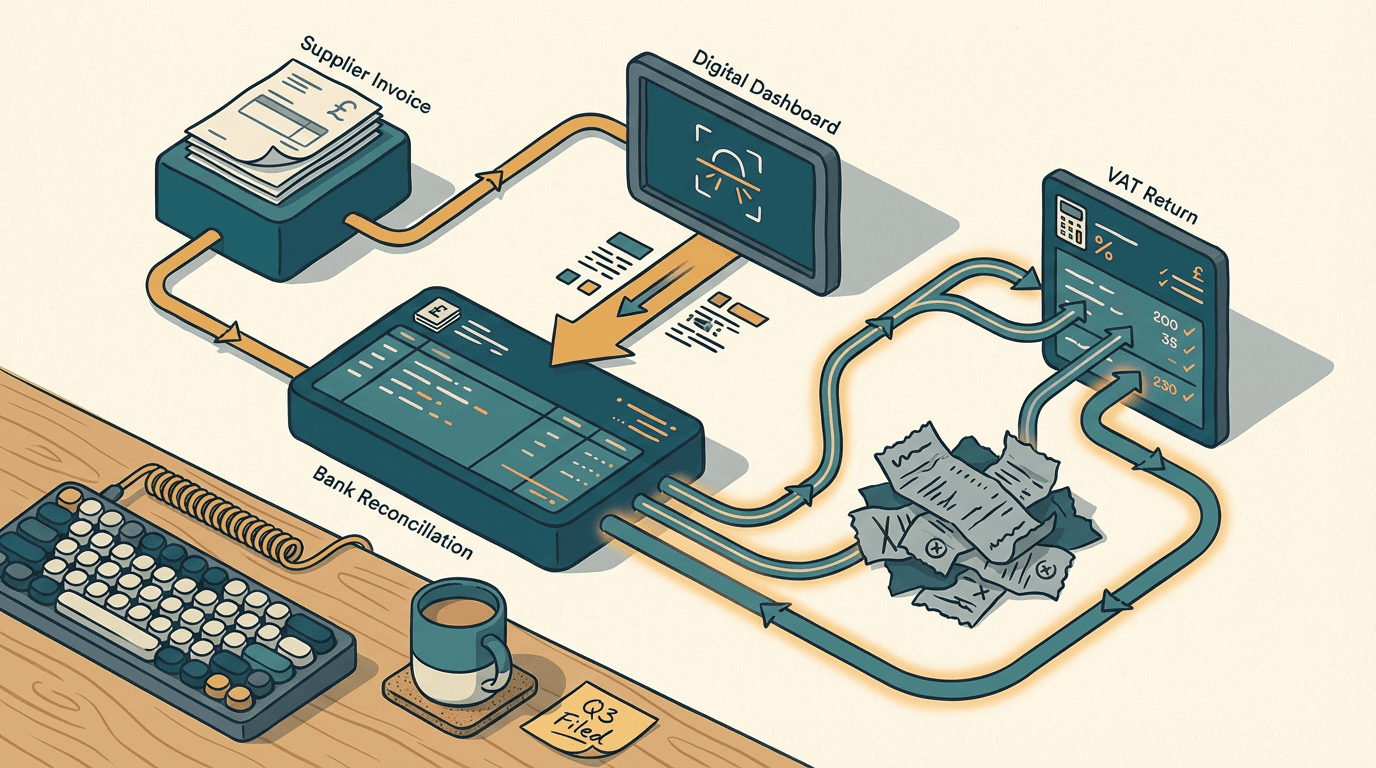
Here is what actually happens when you do this right. A supplier emails a complex, multi-page PDF invoice. An n8n webhook catches the email. It strips the attachment and sends it to the Claude API.
But it does not ask Claude to just read it. It sends a strict JSON schema. It forces the AI to return exactly the fields you need, in the exact format your database expects.
The webhook parses the JSON. It extracts the supplier name, the date, the line items, and the total amounts. Then it makes a PATCH request to the Xero API, updating the invoice line items directly. No human touches it. The invoice just lands in Xero, fully coded and ready for approval.
This is not a toy. This is a commercial system. A build like this typically takes 2-3 weeks of focused work. You should expect to spend £6k to £12k depending on your existing integrations.
That sounds like an investment. But compared to the £40k reconciliation tax, the payback period is measured in months.
You have to build in safety nets. AI models hallucinate. They will occasionally invent a number or misread a decimal point. If you let an AI write directly to your ledger without checks, you are asking for a disaster.
You catch these failures with deterministic code. Inside the n8n workflow, you add a Python node. The Python script takes the line items extracted by Claude and adds them up.
It checks if the sum matches the total invoice amount. If it matches, the data goes to Xero. If it fails, the workflow skips Xero and sends a Slack message to your operations manager for review.
AI does the messy reasoning. Code does the strict math. That is the secret. You get the flexibility of a human reader with the reliability of a calculator. This is how you ship real systems.
Where this breaks down
This system breaks down when your input data requires human interpretation of physical artifacts rather than digital text. You need to know exactly what you are feeding into the machine before you start building.
If your invoices come in as scanned TIFFs from legacy accounting software, you need OCR first. The error rate jumps from 1% to around 12%.
Claude is brilliant at reading native PDFs. It struggles when it has to squint at a blurry photograph of a receipt taken in a dark cab. The AI will guess, and guessing in finance is fatal.
Also, watch out for undocumented business logic. If your accounts assistant knows that a specific client always gets a 10% discount, but that rule lives entirely in her head, the AI will fail. The machine only knows what is written down. It cannot read minds.
Do a strict audit before you write a single line of code. Map out every exception. If your process relies on "just knowing" how to handle a weird edge case, you cannot automate it yet. Fix the process. Write down the rules. Standardise the inputs. Then bring in the automation.
Three questions to sit with
- How many hours a week does your highest-paid operations staff member spend copying data between tools that should already be connected?
- If your invoice volume doubled tomorrow, would your current software stack handle the load, or would you be forced to hire another full-time administrator?
- Are you paying for generic AI subscriptions that your team uses as a toy, or are you investing in headless systems that actually enforce your business logic?
Get our UK AI insights.
Practical reads on AI for UK businesses — teardowns, how-to guides, regulatory news. Unsubscribe anytime.
Unsubscribe anytime.