Eliminate the HR Transcription Tax With Agentic AI Workflows
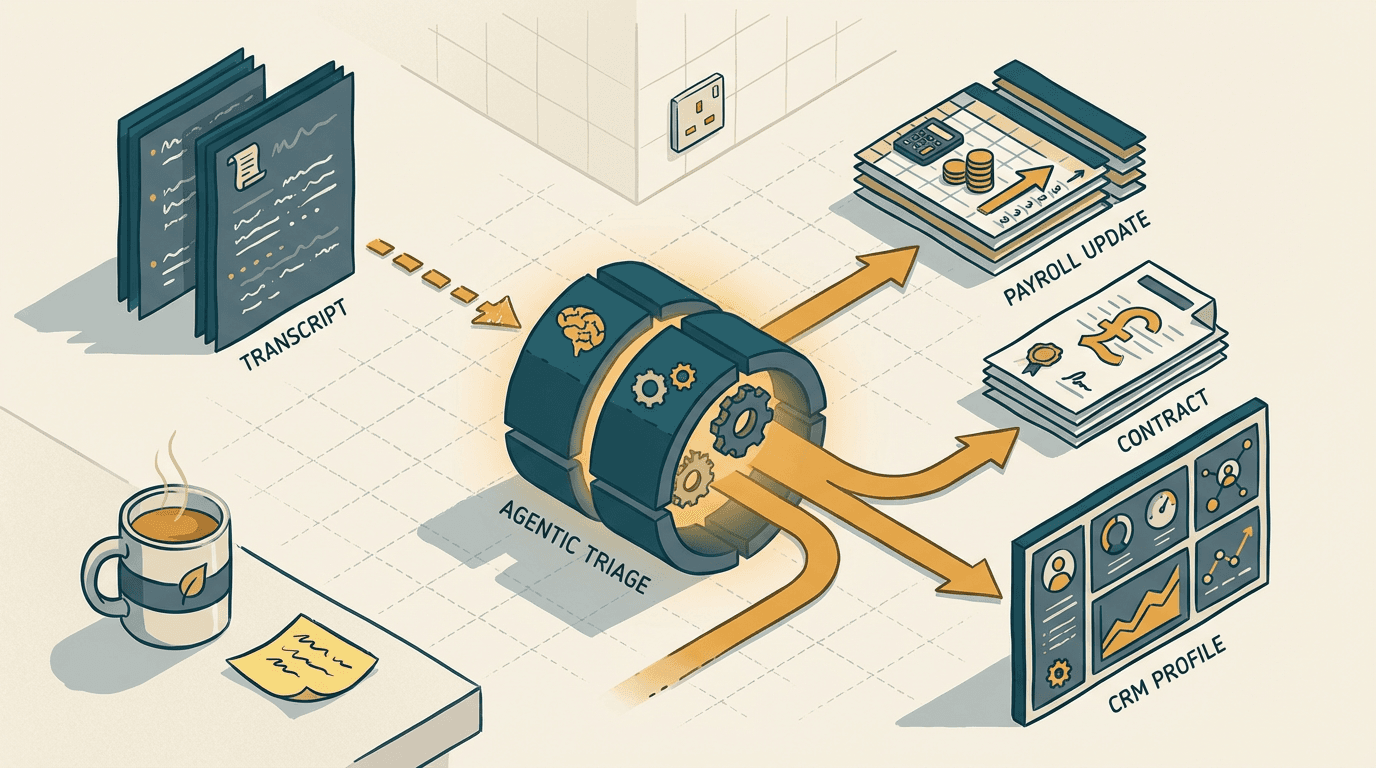
Look at your operations manager's screen right now. There is a signed employment contract sitting as a PDF attachment in Outlook. Next to it is a Slack message from IT asking what laptop the new hire needs, and an email from payroll chasing the P45.
Your ops manager is going to open that PDF, read the start date, copy it into Google Calendar, paste the salary into Xero, and manually email IT to provision a Microsoft 365 account.
This is exactly how most UK SMEs run their people ops. It is slow, it is prone to typos, and it burns up your most capable talent on raw data entry.
In December 2025, OpenAI and Accenture signed a massive deal to push agentic AI deeply into enterprise HR. But you don't need a multi-million-pound consulting contract to build this. You just need to understand how the plumbing works.
The HR transcription tax

The HR transcription tax is the invisible salary cost of paying intelligent humans to copy data between emails, PDFs, and your core systems. It is the silent killer of productivity in growing businesses.
When you are a team of ten, this tax is negligible. Your ops manager spends maybe an hour a week setting up new hires or processing leave requests. It feels like normal administrative work.
But as you scale past thirty employees, the volume of data moving between systems multiplies. Every new hire, promotion, or exit triggers a cascade of manual updates across Xero, Slack, Google Workspace, and your pension portal.
Your ops manager stops building systems and becomes a human router. They spend their days dragging information from one browser tab to another. You are paying a £45k salary for someone to act as a very slow, error-prone API.
This is exactly what the enterprise end of the market is currently eliminating. In December 2025, OpenAI and Accenture announced a major partnership to accelerate enterprise reinvention [source](https://newsroom.accenture.com/news/2025/openai-and-accenture-accelerate-enterprise-reinvention).
They are specifically targeting core corporate functions like HR and finance with agentic AI. These are systems that take action, not just chat. They read the contract, update the database, and provision the software seats automatically.
The deal signals a permanent shift in how businesses operate. Accenture is equipping tens of thousands of its professionals with ChatGPT Enterprise to build these very systems for Fortune 500 clients. They are using tools like OpenAI AgentKit to rapidly design and deploy custom AI agents.
If the largest companies in the world are stripping out the HR transcription tax, SMEs can no longer afford to pay it. The baseline for operational efficiency has permanently shifted. You cannot compete if your back office runs on copy-and-paste.
Why the obvious fix fails
The obvious fix of buying an off-the-shelf AI chatbot or wiring up a basic Zapier flow fails because these tools lack the agency to handle nested logic and missing data.
Most SMEs who try to automate their HR hit this exact wall. They buy a £25/month ChatGPT Plus subscription, tell their admin team to use AI, and expect magic. Or they try to wire up a basic Zapier flow.
Not Xero integration. Not proper automation. Just a disconnected chatbot and a brittle Zap.
Here is what actually happens when you try to automate employee onboarding with basic Zapier steps. Zapier triggers on a new email and sends the attached PDF to an off-the-shelf AI parser to extract the details.
But Zapier's Find steps cannot nest. When your HR platform has a custom department field two levels deep, the automation cannot map the extracted text to the right database ID.
It silently writes null. When Zapier tries to push that null value into a required field in your HR system, the API rejects the payload. The automation silently dies. There is no alert.
You only find out at the end of the month when payroll runs and the new employee is completely missing from Xero. And yes, that's annoying.
The pattern I keep seeing is founders treating AI as a magic wand rather than a software component. A ChatGPT window cannot log into your accounting software. It cannot provision a Google Workspace account.
Founders assume that because Claude can write a brilliant marketing email, it can naturally figure out how to parse a P45. But reasoning is not the same as routing.
When you ask an accounts assistant to onboard a hire, they intuitively know to check if the sort code has six digits. A generic LLM prompt does not. It just hallucinates a missing digit to make the output look correct, and your payment bounces.
To actually eliminate manual HR work, you need agentic workflows. You need to connect the reasoning engine of an LLM directly to the APIs of your core business tools. Relying on basic point-to-point Zaps will just break your data architecture.
The approach that actually works

The approach that actually works requires an orchestration layer like n8n to handle logic, a frontier model like Claude to handle reasoning, and strict JSON schemas to structure the data.
We use n8n as the orchestration engine. It is far more reliable than Zapier for complex logic. When a signed employment contract lands in a specific Gmail folder, an n8n webhook triggers the workflow.
n8n extracts the PDF attachment and passes it to the Claude API. But we do not just ask Claude to summarise this document. That guarantees a hallucinated mess.
Instead, we use a strict JSON schema. We force Claude to return a structured data object containing exactly the keys we need: first_name, last_name, start_date, salary, and job_title.
If Claude detects that the start date is missing from the contract, it flags it in the JSON response as "missing_data": true. The webhook parses the JSON.
If data is missing, n8n immediately routes a message to your HR Slack channel. It pings the ops manager to say the contract for John Doe is missing a start date. A human steps in.
We also build in a verification step using Supabase. Before n8n hits the Xero API, it queries a Supabase database to check if an employee with that exact national insurance number already exists.
This prevents duplicate records. If a match is found, the workflow branches. It updates the existing record instead of creating a new one. This kind of conditional logic is impossible with a basic Zap.
If the JSON is complete and valid, n8n moves to the execution phase. It hits the Google Workspace API to create the user's email address and assign them to the right groups based on their job_title.
Then, it PATCHes the Xero payroll endpoint to create a draft employee record with the correct salary. It does not publish it live. It saves it as a draft.
This is the crucial safety net. The AI does the heavy lifting of data extraction and API routing, but a human accounts assistant still clicks approve in Xero before any money moves.
You get the speed of automation with the safety of human oversight. Building a reliable onboarding flow like this takes about 2-3 weeks of build time.
Expect to spend between £6k and £12k depending on how messy your existing integrations are. It pays for itself in the first quarter by freeing your ops team to actually manage people instead of PDFs.
Where this breaks down
This agentic architecture breaks down when it encounters legacy on-premise software without modern APIs or highly unstructured data like handwritten scanned documents.
This architecture is powerful, but it is not a silver bullet. You need to know exactly where the boundaries of the technology lie before you start building.
If your business relies on legacy on-premise software without modern REST APIs, this approach dies on the vine. n8n cannot push data into a closed database sitting on a server in your basement.
You also hit a wall with poor document quality. If your new hires print their contracts, sign them with a ballpoint pen, and upload crooked, poorly lit photos from their mobile phones, the process breaks.
The OCR step fails to read the text accurately. The error rate jumps from 1% to something closer to 12%. The system spends more time asking for human review than it saves.
It is also worth noting the limits of AI reasoning on unstructured data. If an employee replies to an onboarding email with a long story about why their P45 is delayed, the JSON schema extraction might fail.
The LLM gets confused by the narrative. You need a fallback route that strips the attachment and forwards the raw email to a human.
Finally, highly complex edge cases still require human intervention. If an employee has a non-standard visa requirement or a highly bespoke commission structure, the AI will struggle to map it to standard Xero fields.
You have to design the system to handle the 80% of standard, boring cases automatically, and gracefully route the complex 20% to your ops manager.
The question isn't whether AI replaces your ops manager. It's whether you know which £32k of her week is actually spent copying data from DocuSign into Xero, because that is the only part a bot can touch this year. The December 2025 Accenture deal proves that agentic workflows are no longer experimental. They are the new baseline for how businesses operate. If you are still paying humans to act as routers between your software platforms, you are bleeding margin. Stop buying generic AI subscriptions and hoping your team figures it out. Start mapping your data flows, define your JSON schemas, and wire your tools together. The technology is already here, and it works. You just have to build it.
Get our UK AI insights.
Practical reads on AI for UK businesses — teardowns, how-to guides, regulatory news. Unsubscribe anytime.
Unsubscribe anytime.